| Title | Partition of India (Unit 12) |
|---|---|
| Subject | Modern Indian History |
| Category | History of India | Partition of India Studies |
| Institution | Indira Gandhi National Open University (IGNOU) |
| Number of Pages | 15 |
| Language | English |
| File Type | |
| File Size | 214. KB |
| Country of Publication | India |
| Main Topics | Introduction to Partition of India, British divide and rule policies, Muslim League and Muhammad Ali Jinnah, Role of Indian National Congress, Gandhi and partition politics, 1946 elections and public opinion, Cabinet Mission Plan, Socio-economic causes of partition, Communal tensions in Punjab and Bengal, Historical analysis of India-Pakistan partition |
Summary Note of this Document
This academic unit, named "The Partition of India, " provides a thorough historical examination of the partition of British India into India and Pakistan in 1947. The unit highlight that the British colonial rule had imposed political unity in India, but eventually the country was divided due to a complicated interacting of political, social, economic, and communal factors. It points out that partition was neither an inevitable nor a single, person decision, but was the outcome of the events between 1937 and 1947, which involved the British government, the Indian National Congress, and the Muslim League.
British Colonial Policies and Divide, and, Rule Strategy:
The text reveals how various British colonial policies, like separate electorates and census classification, led to the religious communities' identification with their religions more vividly and created far, reaching divisions between the communities. Such policies fostered competition and mistrust between the religious communities, thus had a great impact on the disintegration of national unity and ultimately the partition of the country. Role of the Muslim League and Muhammad Ali Jinnah: The section analyses the Muslim Leagues evolution from a moderate political party to a powerful political force demanding a separate state. Jinnah's political strategy, communal polarization, and the League's growing popularity, especially after the 1946 elections, were crucial factors in the demand for Pakistan. Congress Leadership and Political Decisions:
The lead of the Congress had the vision of a unified Indian nation and thus it faced major criticisms for its majoritarian policy and failure to bring the Muslim political interests fully onboard. It favored a strong central government and hence rejected the compromises with the federalism such as the Cabinet Mission Plan, this led to some stalemate in politics and tensions rose.
Gandhis Efforts to Preserve National Unity:
Mahathma Gandhi was vehemently against partition and kept opposing it. He had given his whole life to communal harmony and Hindu, Muslim unity. Besides he even offered political compromises on a grand scale for how the division could be avoided but distrust between the two communities and the political situations restricted his guiding role in the final decisions taken.
1946 Elections and Rise of Popular Support for Pakistan:
The 1946 elections in which the Muslim League sides won a landslide victory among Muslim voters pushed its claimforward that it was the sole representative of Muslims. This great success at the polls, rocked the demand for Pakistan more than ever and political compromise is made quite difficult.
Social and Economic Factors Behind Partition:
Besides highlighting the immediate causes, the text also reveals a number of other reasons such as economic injustices, the problem of different regions, the interests of different classes, and political rivalries in the provinces of Punjab and Bengal. Such in, depth causes spread the communal conflicts and thus finding a political solution became a bigger challenge.
Conclusion and Historical Significance:
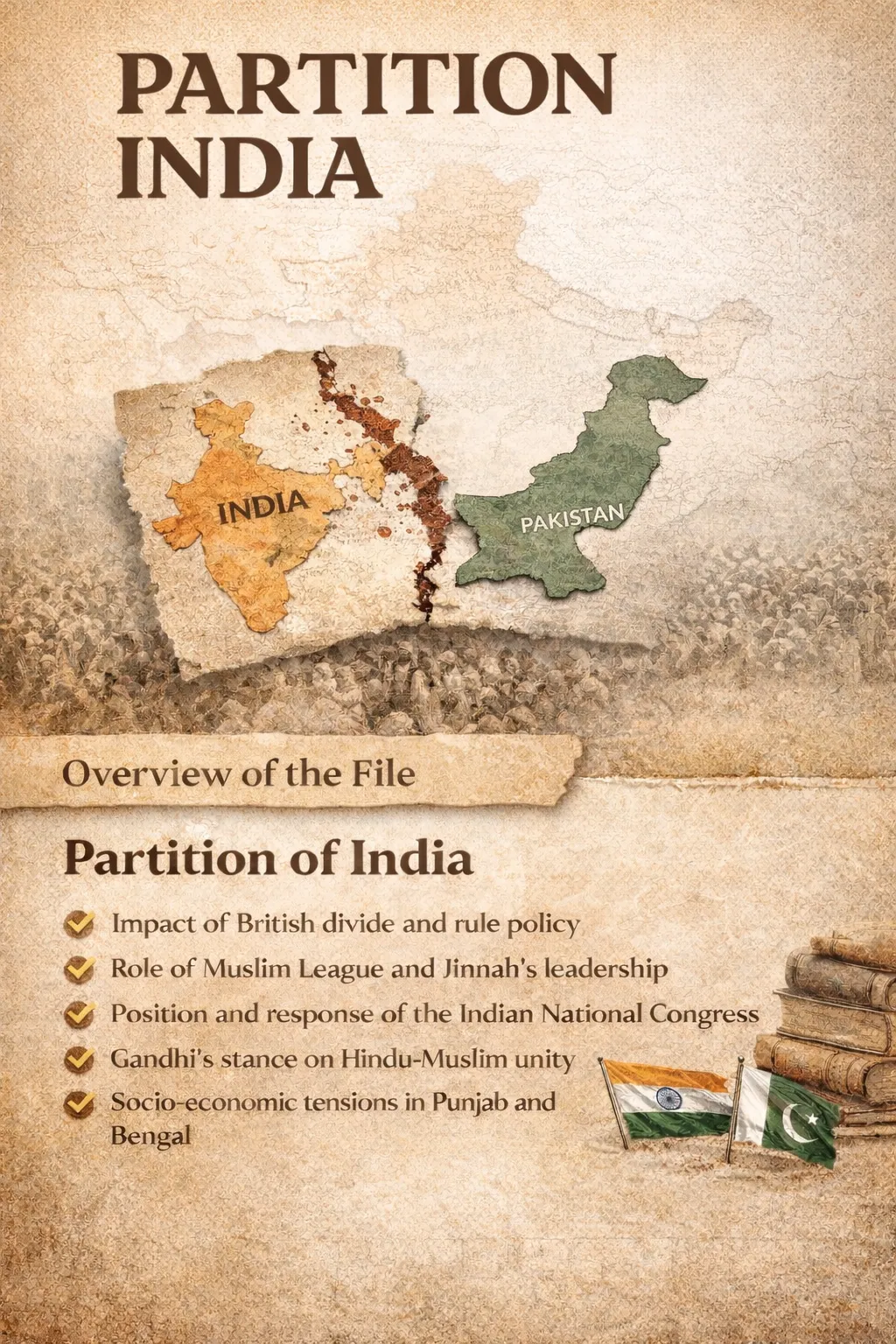
This part of the book in addition to other events says that the major historical forces coming together were the main reason the country got divided and no one person was responsible. Among other factors the outbreak of rivalry between the two main political parties, the colonial Governments measures, the economic discontents and the widening communal unfamiliarity together brought about maybe the greatest and most tragic event in the recent history of South Asia.