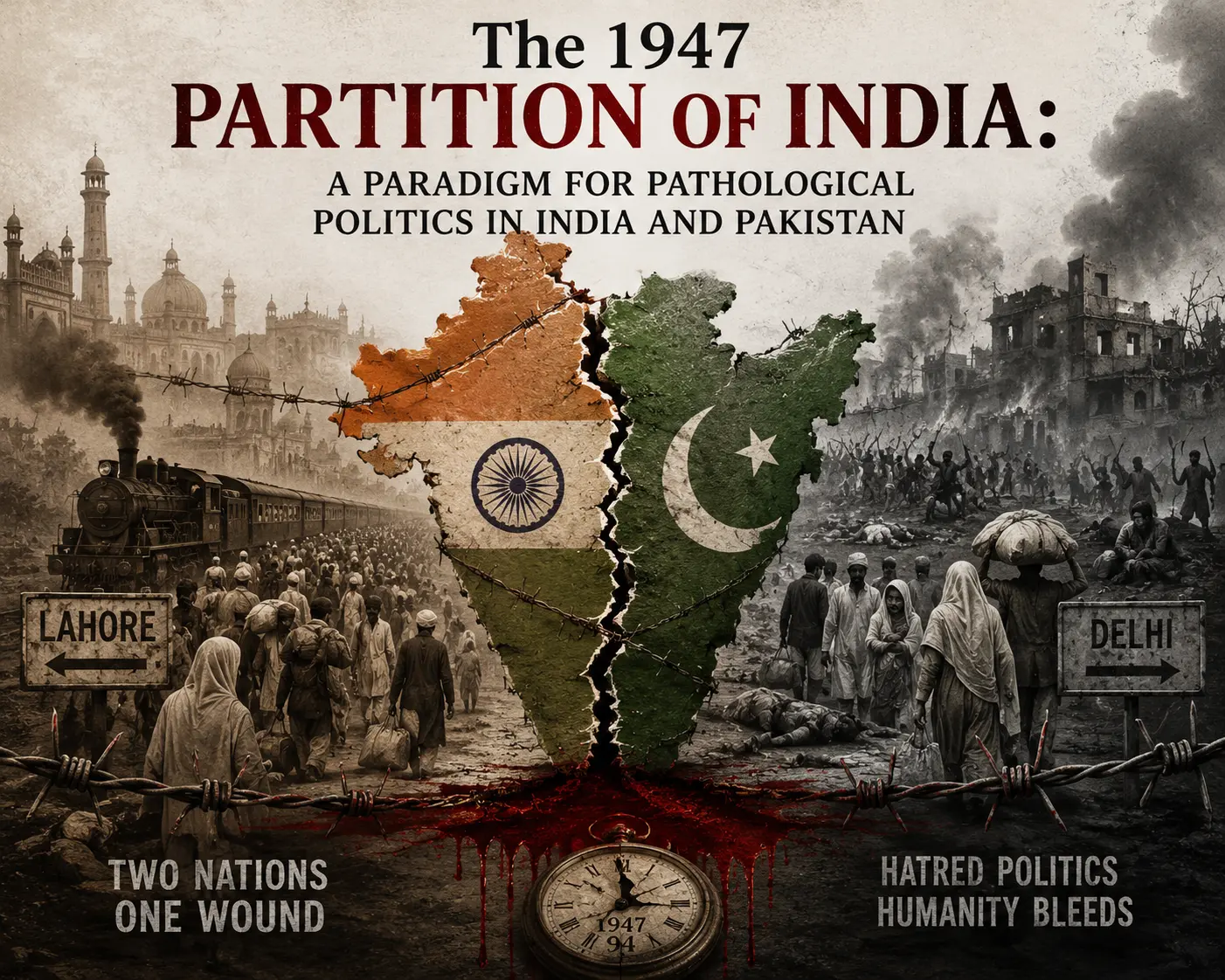
A symbolic representation of the 1947 Partition of India, highlighting the mass migrations, communal violence, and enduring political tensions that shaped the histories of India and Pakistan. The divided map, refugee movements, and scenes of destruction reflect one of the largest and most traumatic population displacements in modern history.
1. Structural Concepts of Pathological Politics
Professor Ahmed defines a pathological socio-political system as one that relies on maintaining internal anxieties and demonizing an out-group to sustain state narratives. Instead of normal political negotiation, the state mechanics operate on rejection, exclusion, and implicit threats of force. This structural trauma operates differently across the borders:
- Pakistan's Security Syndrome: Rooted in an elite and popular anxiety over potential "Hindu domination," the state quickly concentrated power within a dominant military-bureaucratic establishment, often sidelining democratic development to protect sovereignty.
- India's Internal Strains: Despite establishing a resilient secular democracy, India faces its own majoritarian pathologies where right-wing political factions weaponize historic memories of Partition to challenge the loyalty of minority communities.
2. The Three-Way Responsibility
The core thesis emphasizes that blame cannot be pinned on a single entity. Instead, it argues that a complex three-way interaction locked the region into conflict:
- The British Rule: Applied institutionalized "Divide and Rule" tactics and rigid separate electorates based on religion, freezing identities.
- The Congress: Insisted on a strictly centralized secular model that alienated regional Muslim political leadership.
- The Muslim League: Mobilized mass fear of majoritarian rule to demand an independent homeland without providing a clear operational blueprint for a physically divided nation.
3. Documented Metrics of the Humanitarian Crisis
The scale of the human toll in Punjab and Bengal provided the emotional and psychological trauma that permanently anchored this pathological political paradigm:
| Impact Category | Estimated Academic Figures (2002) |
|---|---|
| Total Lives Lost | Approximately 2,000,000 casualties |
| Forced Border Migration | 12,000,000 to 15,000,000 refugees |
| Victimized & Abducted Women | Estimated minimum of 75,000 cases |
| Strategic Flashpoints | Jammu and Kashmir / Nuclear Standpoint |
4. Breaking the Hostility Loop
With both nations possessing nuclear arsenals since 1998, conventional conflict runs the risk of absolute mutual destruction. Ahmed concludes that standard political diplomacy or superficial dialogue is insufficient.
True resolution demands an intellectual and grass-roots shift that embraces a process of mutual forgiveness for the shared atrocities committed during Partition, combined with active steps to deconstruct state-sponsored enemy images.
Access the Complete Reference Document
Download the fully detailed, clean, print-ready PDF overview of this historical analysis for your academic research or private archive.
📥 Download full PDF