 |
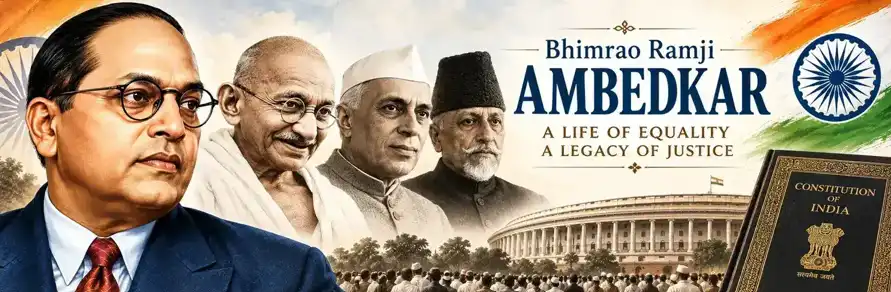
| 125 BIRTH ANNIVERSARY OF DR. B. R. AMBEDKAR — A representative image. |
File Information
| Document Information | Details |
|---|---|
| Title | Dr. Ambedkar Foundation (Ministry of Social Justice & Empowerment Govt. of India) |
| Article Credit | (Pubd in: ac.org.in) |
| Subject | Ambedkar's biography, Indian Constitution, social justice, Dalit empowerment, education, economic development, women empowerment, Buddhism, and government commemorative programmes. |
| Category | Collected Works |
| Number of Pages | 56 |
| Language | English |
| File Type | |
| File Size | 6.56 MB |
Summary Note of this Document
125 BIRTH ANNIVERSARY OF DR. B. R. AMBEDKAR
This 56-page publication documents the life and contributions of Dr. B. R. Ambedkar and the nationwide and international programmes organised by the Government of India to commemorate his 125th birth anniversary.
1. Dr. B. R. Ambedkar: A Profile
Pages 3–5 provide a brief biography of Ambedkar.
Born on 14 April 1891 at Mhow, in present-day Madhya Pradesh.
Studied at Bombay University and pursued higher education in the United States and the United Kingdom.
Became an important scholar of economics, law, politics and social reform.
Served as India's first Law Minister after independence.
Chaired the Drafting Committee of the Indian Constitution.
Dedicated his life to equality, social justice, education and the rights of marginalised communities.
Embraced Buddhism on 6 December 1956, shortly before his death.
2. Ambedkar International Centre
Pages 7–9 describe the foundation stone ceremony of the Dr. Ambedkar International Centre in Janpath, New Delhi, on 20 April 2015.
The proposed centre included:
A public library.
A research and extension centre.
A media and interpretation centre.
A convention centre.
Two auditoriums.
An exhibition on Ambedkar's life.
The centre was intended to promote research, education and awareness of Ambedkar's ideas.
3. Educational and Research Initiatives
Pages 13–14 discuss a study tour involving 100 research scholars who visited the United States and the United Kingdom.
The programme included visits to:
Columbia University, where Ambedkar studied.
The London School of Economics.
Places associated with his life and education in London.
The purpose was to help scholars understand Ambedkar's academic journey and intellectual contributions.
4. Nationwide Commemorative Programmes
The book records several national activities:
Celebration of the first Constitution Day on 26 November 2015.
Release of commemorative postal stamps and coins.
Observance of the 60th Mahaparinirvan Diwas.
National conferences on industrialisation and entrepreneurship.
Youth programmes promoting national unity.
Essay competitions, quizzes and educational activities.
Establishment of Ambedkar Chairs at universities and institutions.
5. Social and Economic Development
Pages 24–32 highlight initiatives connected with the economic and social empowerment of Scheduled Castes and other disadvantaged communities.
These include:
Increasing the authorised share capital of the National Scheduled Castes Finance and Development Corporation from ₹1,000 crore to ₹1,500 crore.
Educational awards for students.
Support for entrepreneurship and employment.
Rural development initiatives under the Gram Uday Se Bharat Uday Abhiyan.
Programmes promoting women's participation and social inclusion.
6. International Commemorations
Pages 17–18 and 39–40 document celebrations at Indian diplomatic missions and institutions abroad.
Activities included:
Seminars and lectures on Ambedkar.
Exhibitions and documentary screenings.
Discussions on the Indian Constitution.
Cultural and educational programmes.
Events at Indian embassies and consulates.
7. Important Speeches and Documents
The final section includes:
Minutes of the National Committee meeting chaired by the Prime Minister.
The Prime Minister's speech at the release of commemorative coins.
The address at the National Conference of Dalit Entrepreneurs organised by DICCI.
The Ambedkar Memorial Lecture.
Official government notifications and committee documents.
These sections discuss constitutional values, social equality, entrepreneurship, education, economic empowerment and the continuing relevance of Ambedkar's ideas.
Core Themes
- Not clearly stated in the document.
Keywords
About Dr. B. R. Ambedkar
Bhimrao Ramji Ambedkar was born in 1891 as the fourteenth and youngest child of an army Subedar in Mhow. Born into the Mahar caste, which was considered untouchable, Bhimrao faced many hardships at school. He had to sit on a gunny sack that he brought from home. He was not allowed to touch the water vessel or cup, so he could drink water only when the school peon was present to pour it for him. He later described this experience with the words, “No peon, no water.” His mother died when he was very young, and he had a difficult childhood. However, he was the only one of his siblings to pass his examinations and continue to high school, becoming the first person from his community to attend Elphinstone College. With a scholarship from the Maharaja of Baroda, he went on to study at Columbia University and the London School of Economics. He earned doctorates in economics and trained as a barrister at Gray’s Inn. According to the account supplied for this biography, his books were lost when his ship was torpedoed during the First World War.
Despite his education, Ambedkar continued to face prejudice. When he returned to India, he was required to work in Baroda but had to leave the position because of discrimination. His business providing investment consultancy failed when clients learned that he belonged to a community considered untouchable. While working as a professor in Mumbai, his colleagues objected to the idea of him sharing a water jug with his students. These experiences helped spur his activism. He established newspapers to give a voice to marginalized people. He led the Mahad Satyagraha, asserting Dalits’ right to collect water from a public tank, and publicly burned the Manusmriti in 1927. In 1932, he negotiated the Poona Pact with Mahatma Gandhi. Although it involved a difficult compromise, the pact provided reserved seats in legislatures for the Depressed Classes. Ambedkar was outspoken in public life but private by nature. His wife Ramabai died in 1935, and he filled his home in Bombay with a large personal library reported to contain more than 50,000 books. He declared, “I am born a Hindu, but I will not die as one.”
During the period of Indian independence, Jawaharlal Nehru invited Ambedkar to become India’s first Law Minister. Ambedkar chaired the Drafting Committee that prepared the Constitution of India, which abolished the practice of untouchability and established civil liberties and constitutional safeguards, including reservations for historically oppressed communities. He acknowledged the contribution of other constitutional experts, including B. N. Rau, who had prepared an earlier draft. Because of his poor health, including diabetes, Ambedkar married Savita, a doctor who cared for him. In October 1956, he converted to Buddhism in Nagpur along with a vast gathering of followers, commonly estimated at around half a million. He died in his sleep just weeks later, shortly after completing his final major work, The Buddha and His Dhamma. He was posthumously awarded the Bharat Ratna in 1990. His message, “Educate, agitate, organise,” continues to inspire people seeking equality and social justice.
Complete Ambedkar Research Collection
Download the entire collection of Ambedkar research PDFs available on HISTORY MARG