File Information
| Document Information | Details |
|---|---|
| Title | Sanskrit Literature: A Source of Inspiration for Mahatma Gandhi |
| Article Credit | International Referred Online Research journal, ISSN: 2319-6904, Issue: XXIV, Year: 2014, (Pubd in: Academia.edu) |
| Author | Dhananjay Vasudeo Dwivedi (Ranchi University, Faculty Member) (Assistant Professor, Department of Sanskrit, Ranchi College, Ranchi, Jharkhand-834008) |
| Subject | This article examines how Mahatma Gandhi's core principles—truth, non-violence, fearlessness, dignity of women, God, dharma, brahmacharya, cow protection, and prayer—were inspired by Sanskrit literature, citing specific verses from texts like the Mahabharata, Manusmriti, and the Vedas. |
| Category | Academic Article |
| Institution | Ranchi College, Ranchi, Jharkhand |
| Country of Publication | India |
| Main Topics | Gandhi's philosophy of truth, Non-violence (Ahimsa) in Sanskrit texts, Fearlessness in Gandhian thought, Dignity of women in Sanskrit literature, Concept of God in Sanskrit scriptures, Dharma as a guiding principle, Brahmacharya and self-restraint, Cow protection in Hindu culture |
| Number of Pages | 51 |
| Language | English |
| File Type | |
| File Size | 270.2 KB |
Summary Note of this Document
This article by Dr. Dhananjay Vasudeo Dwivedi argues that Mahatma Gandhi's ethical and spiritual philosophy was profoundly influenced by Sanskrit literature. The author systematically examines Gandhi's views on truth, non-violence, fearlessness, the dignity of women, God, dharma, brahmacharya, cow protection, and prayer, and then presents corresponding Sanskrit verses from texts such as the Mahabharata, Manusmriti, the Vedas, the Upanishads, and the Bhagavad Gita. For each theme, the article demonstrates parallels between Gandhi's statements and ancient scriptural teachings, suggesting that Gandhi drew inspiration from these sources. The article emphasizes that Gandhi regarded Sanskrit as the bedrock of Indian culture and that his ideas were not novel but rooted in timeless wisdom. The author concludes that Sanskrit literature provided Gandhi with a moral framework that guided his actions and leadership. The article is scholarly, with extensive citations from both Gandhian works and Sanskrit scriptures, and it contributes to understanding the intellectual foundations of Gandhi's thought.
Core Themes
- Influence of Sanskrit scriptures on Gandhi
- Truth as a central virtue
- Ahimsa as a universal principle
- Role of dharma in personal and social life
- Respect for women in ancient Indian texts
Keywords
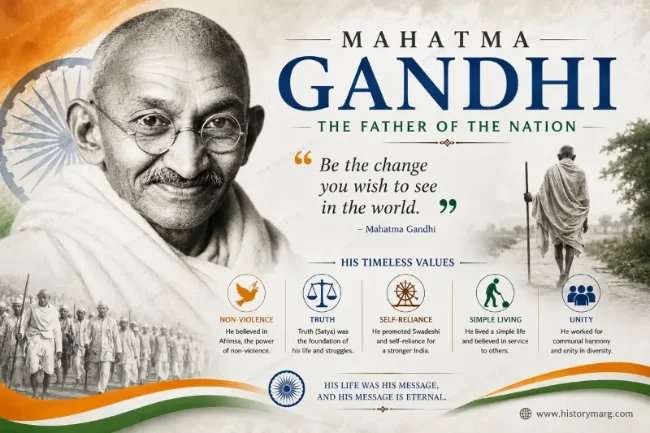
About Mahatma Gandhi
Mohandas Karamchand Gandhi lived from 1869 to 1948. Born in India, he trained as a lawyer and became a political thinker. Colonial rule repelled him. He opposed it fiercely and eventually led India’s independence movement.
Gandhi pioneered Satyagraha, the power of truth and nonviolent resistance. He put these ideals into practice during political and social upheavals. Over twenty years in South Africa shaped his thinking. That’s where he developed his tactics of nonviolent defiance. He returned to India in 1915 and launched major movements against British rule. Non-Cooperation Movement. Salt March. Quit India Movement. Each one challenged colonial domination.
In 1883 he married Kasturba Gandhi. Marriage and family life remained central to who he was. He spoke powerfully about his beliefs. His writing included Hind Swaraj, Satyagraha in South Africa, and The Story of My Experiments with Truth, his autobiography.
His vision stretched beyond political independence. Religious harmony mattered to him. Social equality. Self-reliance. Women’s rights. Ending untouchability. All of these were part of what he fought for.
Nonviolence and Satyagraha shaped movements worldwide. Civil rights activists drew from his example. Freedom struggles across the globe felt his influence. His approach changed how people thought about resistance and change.
Complete Gandhi Research Collection
Download the entire collection of Gandhi research PDFs available on HISTORY MARG