File Information
| Document Information | Details |
|---|---|
| Title | Relevance of Gandhi in Politics |
| Article Credit | Academia.edu |
| Author | Dr. Deepika Dhand |
| Subject | An academic paper examining the political philosophy of Mahatma Gandhi, focusing on Satyagraha, Swaraj, and their global relevance. |
| Category | Political Science |
| Institution | MATS University |
| Country of Publication | Not clearly identified in the document. |
| Main Topics | Gandhi's political philosophy and non-violence, Satyagraha and civil disobedience movements, Swaraj and self-rule in Indian independence, Religious tolerance and communal harmony, Swadeshi movement and economic self-reliance, Global influence of Gandhi's ideals, Social reform and caste equality, Gandhi's legacy and modern relevance |
| Number of Pages | 8 |
| Language | English |
| File Type | |
| File Size | 128.9 KB |
Summary Note of this Document
Dr Deepika Dhand, Pro-Vice Chancellor at MATS University, presents an academic analysis of Mahatma Gandhi's enduring relevance in contemporary politics. The article draws on biographical works by historians such as Ramachandra Guha and Dinanath Gopal Tendulkar to trace Gandhi's transformation from a young London law student into a mass leader of India's independence movement. Dhand explores foundational Gandhian ideas including Satyagraha, or civil disobedience, and Swaraj, meaning self-rule, and illustrates their application in movements across the globe, from Martin Luther King Jr.'s civil rights campaign in America to democratic uprisings in Myanmar and Eastern Europe. The paper also examines Gandhi's steadfast commitment to religious tolerance, social equality, and the eradication of untouchability, as well as his vision of an agrarian economy and economic self-reliance through the Swadeshi movement. By detailing major events such as the Dandi March and the Non-Cooperation movement, the author demonstrates how Gandhi's methods of peaceful resistance proved effective against colonial power. The article further considers Gandhi's philosophy as a way of life, his views on vegetarianism and environmental cleanliness, and the global memorialisation of his legacy. Dhand concludes that Gandhi's principles of truth, non-violence, and self-governance remain essential guides for achieving justice and harmony in modern political systems.
Core Themes
- Non-violence and Satyagraha
- Swaraj and self-rule
- Religious pluralism and brotherhood
- Social equality and eradication of untouchability
- Global applicability of Gandhian methods
Keywords
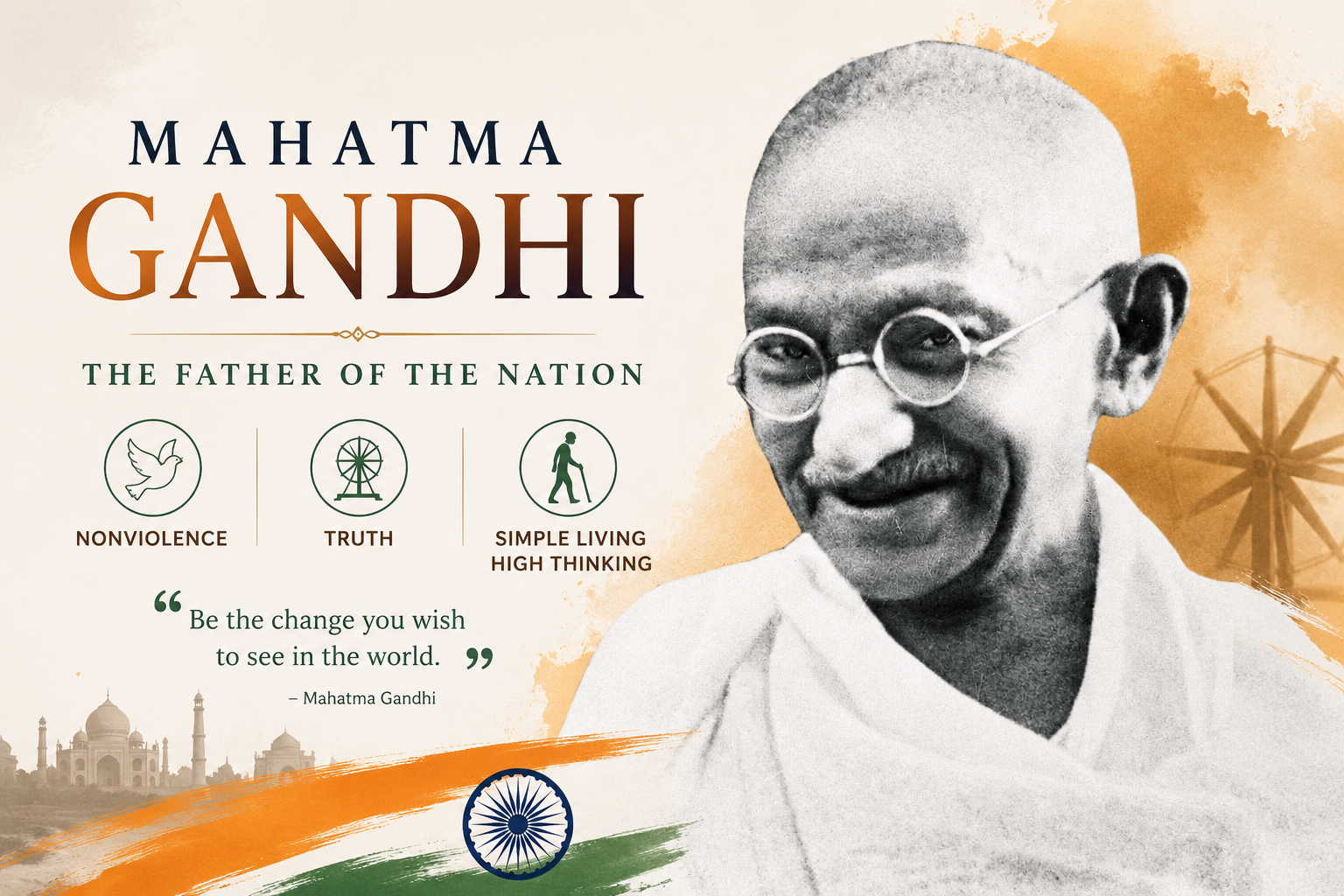
About Mahatma Gandhi
Mohandas Karamchand Gandhi lived from 1869 to 1948. Born in India, he trained as a lawyer and became a political thinker. Colonial rule repelled him. He opposed it fiercely and eventually led India’s independence movement.
Gandhi pioneered Satyagraha, the power of truth and nonviolent resistance. He put these ideals into practice during political and social upheavals. Over twenty years in South Africa shaped his thinking. That’s where he developed his tactics of nonviolent defiance. He returned to India in 1915 and launched major movements against British rule. Non-Cooperation Movement. Salt March. Quit India Movement. Each one challenged colonial domination.
In 1883 he married Kasturba Gandhi. Marriage and family life remained central to who he was. He spoke powerfully about his beliefs. His writing included Hind Swaraj, Satyagraha in South Africa, and The Story of My Experiments with Truth, his autobiography.
His vision stretched beyond political independence. Religious harmony mattered to him. Social equality. Self-reliance. Women’s rights. Ending untouchability. All of these were part of what he fought for.
Nonviolence and Satyagraha shaped movements worldwide. Civil rights activists drew from his example. Freedom struggles across the globe felt his influence. His approach changed how people thought about resistance and change.
Want more posts about him?