File Information
| Document Information | Details |
|---|---|
| Title | Mohan Das Karamchand Gandhi: Spiritual Guru or Political Leader? |
| Article Credit | Academia.edu |
| Author | Subhadra Mitra Channa |
| Subject | A critical examination of Mahatma Gandhi's life and leadership, analysing the interplay between his spiritual persona and political strategies in mobilising Indian masses against colonial rule. |
| Category | History |
| Institution | Not clearly stated in the document. |
| Country of Publication | Not clearly stated in the document. |
| Main Topics | Gandhi's spiritual leadership and its role in political mobilisation, Non-violent resistance (Satyagraha) and its impact, Gandhi's personal life: relationships with Kasturba, his sons, and his sexuality, British colonial education and the creation of Indian national consciousness, Gandhi's critics: Ambedkar, Bose, and Hindu fundamentalists, Gandhi's feminine persona and gender ideology, Gandhi's legacy in modern India |
| Number of Pages | 26 |
| Language | English |
| File Type | |
| File Size | 451.2 KB |
Summary Note of this Document
This paper by Subhadra Mitra Channa examines whether Mohandas Karamchand Gandhi's effectiveness as a political leader was contingent upon his image as a spiritual guru. Drawing on biographical details, the author argues that within the Indian ethos, spiritual authority carries the highest legitimacy, and Gandhi deliberately cultivated an ascetic, saintly persona to mobilise the masses, who traditionally accepted rulers only when they upheld dharma and acted as parental protectors. The overview traces Gandhi's early life, his transformation from a London-educated lawyer to a Mahatma, and his use of non-violent protest, fasting, and self-purification as political tools. It discusses his complex personal relationships, including his strained marriage with Kasturba, his guilt over sexuality, and his efforts to embody an androgynous ideal that combined feminine qualities of care and non-violence. The paper also addresses Gandhi's detractors, including B.R. Ambedkar, who sought political power for untouchables rather than paternalistic reform, and Subhas Chandra Bose, who advocated armed resistance. Finally, it evaluates Gandhi's legacy, noting his influence on global non-violent movements, his critique of Western industrial capitalism, and his vision of social and economic justice building from the bottom up. The author concludes that Gandhi was both a spiritual and political leader whose emphasis on ethical means redefined modern protest.
Core Themes
- Sacred and political authority in Indian culture
- Charisma and asceticism in Indian leadership
- Non-violence as political weapon
- Gender and masculinity in Gandhi's philosophy
- Caste, untouchability, and Gandhi's reformative approach
Keywords
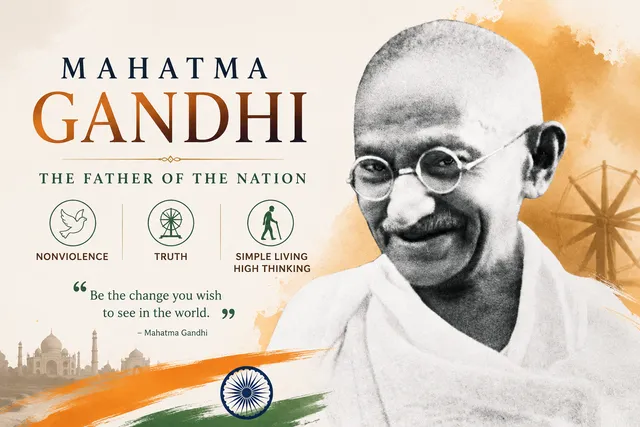
About Mahatma Gandhi
Mohandas Karamchand Gandhi lived from 1869 to 1948. Born in India, he trained as a lawyer and became a political thinker. Colonial rule repelled him. He opposed it fiercely and eventually led India’s independence movement.
Gandhi pioneered Satyagraha, the power of truth and nonviolent resistance. He put these ideals into practice during political and social upheavals. Over twenty years in South Africa shaped his thinking. That’s where he developed his tactics of nonviolent defiance. He returned to India in 1915 and launched major movements against British rule. Non-Cooperation Movement. Salt March. Quit India Movement. Each one challenged colonial domination.
In 1883 he married Kasturba Gandhi. Marriage and family life remained central to who he was. He spoke powerfully about his beliefs. His writing included Hind Swaraj, Satyagraha in South Africa, and The Story of My Experiments with Truth, his autobiography.
His vision stretched beyond political independence. Religious harmony mattered to him. Social equality. Self-reliance. Women’s rights. Ending untouchability. All of these were part of what he fought for.
Nonviolence and Satyagraha shaped movements worldwide. Civil rights activists drew from his example. Freedom struggles across the globe felt his influence. His approach changed how people thought about resistance and change.