File Information
| Document Information | Details |
|---|---|
| Title | Biography Mahatma Gandhi : A Life Sketch |
| Article Credit | Academia.edu |
| Author | |
| Subject | A biographical account of Mahatma Gandhi's life from his birth in Porbandar to his assassination, focusing on his development of Satyagraha, his campaigns against racial discrimination and colonial rule, and his role in India's independence movement. |
| Category | Biography |
| Institution | Not clearly stated in the document. |
| Country of Publication | Not clearly stated in the document. |
| Main Topics | Gandhi's early life and family in Porbandar and Rajkot, Legal education at the Inner Temple in London, Racial discrimination in South Africa and the birth of Satyagraha, Founding of Natal Indian Congress, Indian Opinion, Phoenix Ashram and Tolstoy Farm, Satyagraha movements in Champaran, Ahmedabad and Kheda, Non-cooperation movement, Rowlatt Bill protest, and constructive programmes, Salt March, Gandhi-Irwin Pact, Round Table Conference and Poona Pact, Quit India movement, independence, partition and assassination |
| Number of Pages | 3 |
| Language | English |
| File Type | |
| File Size | 122.4 KB |
Summary Note of this Document
This document offers a life sketch of Mahatma Gandhi from his birth in Porbandar in 1869 to his assassination in 1948. It traces his early education in Rajkot, his marriage to Kasturbai, and his legal training at the Inner Temple in London. The account then focuses on Gandhi's experience of racial discrimination in South Africa, where his eviction from a first-class train carriage at Maritzburg led him to develop the concept of Satyagraha. It records his establishment of the Natal Indian Congress, the journal Indian Opinion, and the Phoenix and Tolstoy Farm ashrams. On returning to India in 1915, Gandhi led campaigns in Champaran for indigo peasants, in Ahmedabad for mill workers, and in Kheda for farmers, and later launched nationwide civil disobedience against the Rowlatt Bill and the salt tax. The sketch also highlights his constructive programme of khadi, Hindu-Muslim unity, and the removal of untouchability. It covers the Salt March, the Gandhi-Irwin Pact, the Poona Pact, and the Quit India movement, and ends with independence, Gandhi's opposition to partition, and his murder by Nathuram Godse. The text repeatedly stresses the continuing importance of Gandhi's moral and ethical ideas for contemporary society.
Core Themes
- Satyagraha and non-violent civil disobedience
- Struggle against racial discrimination and colonial rule
- Constructive programme: khadi, Hindu-Muslim unity, untouchability, women's equality
- Indian freedom struggle and mass mobilization
- Gandhi's ethical and moral legacy
Keywords
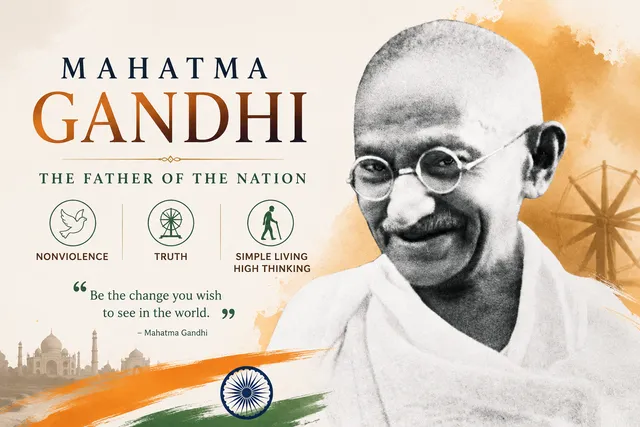
About Mahatma Gandhi
Mohandas Karamchand Gandhi lived from 1869 to 1948. Born in India, he trained as a lawyer and became a political thinker. Colonial rule repelled him. He opposed it fiercely and eventually led India’s independence movement.
Gandhi pioneered Satyagraha, the power of truth and nonviolent resistance. He put these ideals into practice during political and social upheavals. Over twenty years in South Africa shaped his thinking. That’s where he developed his tactics of nonviolent defiance. He returned to India in 1915 and launched major movements against British rule. Non-Cooperation Movement. Salt March. Quit India Movement. Each one challenged colonial domination.
In 1883 he married Kasturba Gandhi. Marriage and family life remained central to who he was. He spoke powerfully about his beliefs. His writing included Hind Swaraj, Satyagraha in South Africa, and The Story of My Experiments with Truth, his autobiography.
His vision stretched beyond political independence. Religious harmony mattered to him. Social equality. Self-reliance. Women’s rights. Ending untouchability. All of these were part of what he fought for.
Nonviolence and Satyagraha shaped movements worldwide. Civil rights activists drew from his example. Freedom struggles across the globe felt his influence. His approach changed how people thought about resistance and change.