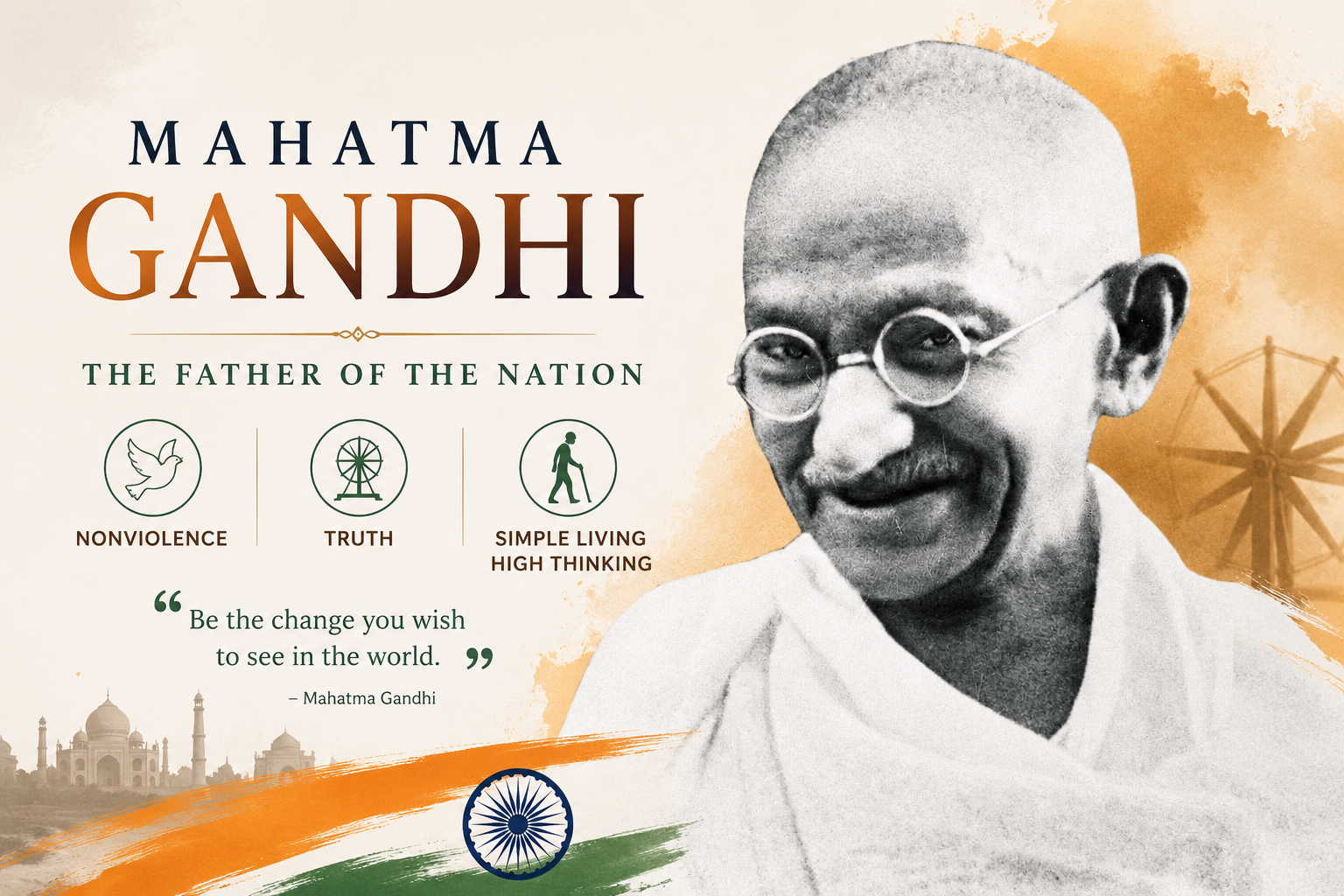
A historical depiction representing Mahatma Gandhi leading followers on a peaceful march to challenge colonial policy.
File Information
| Document Information | Details |
|---|---|
| Title | Gandhi: A prophet of satyagraha and nonviolence |
| Article Credit | Academia.edu |
| Author | Asmat Ullah Wazir and Jamshed Khan |
| Subject | An academic analysis of Mohandas Karamchand Gandhi's philosophy of satyagraha and nonviolence, detailing its conceptual origins, application in South Africa and India, and enduring global impact. |
| Category | History |
| Institution | Quaid-i-Azam University Islamabad and Ara Khel College Kohat |
| Country of Publication | Not clearly stated in the document. |
| Main Topics | Origins and philosophy of Satyagraha, Distinction between passive resistance and truth-force, Anti-discriminatory campaigns in South Africa, Major Indian freedom movements and civil disobedience, Social reform and advocacy for Untouchables, Global adoption of Gandhian protest methods |
| Number of Pages | 5 |
| Language | English |
| File Type | |
| File Size | 156.9 KB |
Summary Note of this Document
This review article provides a comprehensive evaluation of Mohandas Karamchand Gandhi's foundational concepts of satyagraha and nonviolence, examining both their theoretical framework and practical application across historical struggles. The authors trace Gandhi's biographical trajectory from his legal education in England to his early political activism against discriminatory legislation in South Africa, where his strategy of truth-force was first articulated. Upon returning to India, Gandhi integrated satyagraha into the Indian National Congress's agitation against British colonial rule, directing key campaigns including protests against the Rowlatt Act, the Khilafat Movement, non-cooperation, and the historic Salt March of 1930. The text highlights how Gandhi distinguished satyagraha from passive resistance, defining it as a dynamic moral force rooted in truth, compassion, and spiritual strength rather than weakness. Beyond political liberation, the study emphasizes Gandhi's commitment to internal social reform, particularly his advocacy for the dignity and rights of marginalized caste groups known as Untouchables. Finally, the authors analyze Gandhi's broad global legacy, observing how his methods influenced diverse international civil rights leaders and social movements, while noting the paradox that his principle of nonviolence was not fully embraced by post-independence state policies.
Core Themes
- Moral force of truth and love in political resistance
- Distinction between satyagraha and passive resistance
- Intersection of social reform and anti-imperialist agitation
- Ethical dimensions of nonviolent civil disobedience
- Transnational adoption of Gandhian protest techniques