File Information
| Document Information | Details |
|---|---|
| Title | Gandhi: A prophet of satyagraha and nonviolence |
| Article Credit | Academia.edu |
| Author | Asmat Ullah Wazir and Jamshed Khan |
| Subject | A review article examining Mahatma Gandhi's philosophy of Satyagraha and non-violence, tracing its development in South Africa, its use in Indian independence movements, and its legacy for later civil resistance worldwide. |
| Category | History |
| Institution | Ara Khel College Kohat; Department of History, Quaid-i-Azam University Islamabad, Pakistan |
| Country of Publication | Not clearly identified in the document. |
| Main Topics | Gandhi's philosophy of Satyagraha and Ahimsa, Gandhi's early life and legal career, Indian community's struggle in South Africa, Satyagraha movements in India (Rowlatt, non-cooperation, Khilafat), Dandi Salt March of 1930, Gandhi's social reform for untouchables, Global influence of Gandhian nonviolence |
| Number of Pages | 5 |
| Language | English |
| File Type | |
| File Size | 156.9 KB |
Summary Note of this Document
This review article by Asmat Ullah Wazir and Jamshed Khan examines Mohandas Karamchand Gandhi's philosophy of satyagraha and nonviolence as a distinctive method of political and moral struggle. The authors trace Gandhi's evolution from a shy lawyer to the leader of mass movements, emphasizing his early experiences in South Africa where discriminatory laws against the Indian community shaped his approach. They discuss the conceptual meaning of satyagraha as truth-force, distinguishing it from passive resistance, and relate ahimsa to compassion and religious duty. The article surveys major applications of satyagraha in India, including protests against the Rowlatt Act, the non-cooperation movement, the Khilafat campaign, and the Dandi Salt March, noting how Gandhi repeatedly suspended movements when violence erupted. It also addresses Gandhi's social reform work on behalf of untouchables and his impact on later protest leaders in India and worldwide. The authors acknowledge that India's post-independence path diverged from Gandhian values, yet they argue his legacy persisted through figures such as Anna Hazare, Nelson Mandela, and Aung San Suu Kyi. The review concludes by affirming the enduring relevance of Gandhian nonviolence and religious pluralism in global struggles for justice.
Core Themes
- Non-violence as moral and political force
- Truth-force (Satyagraha) vs passive resistance
- Religious pluralism and ahimsa
- Civil disobedience and mass protest
- Gandhi's enduring legacy in global protest movements
Keywords
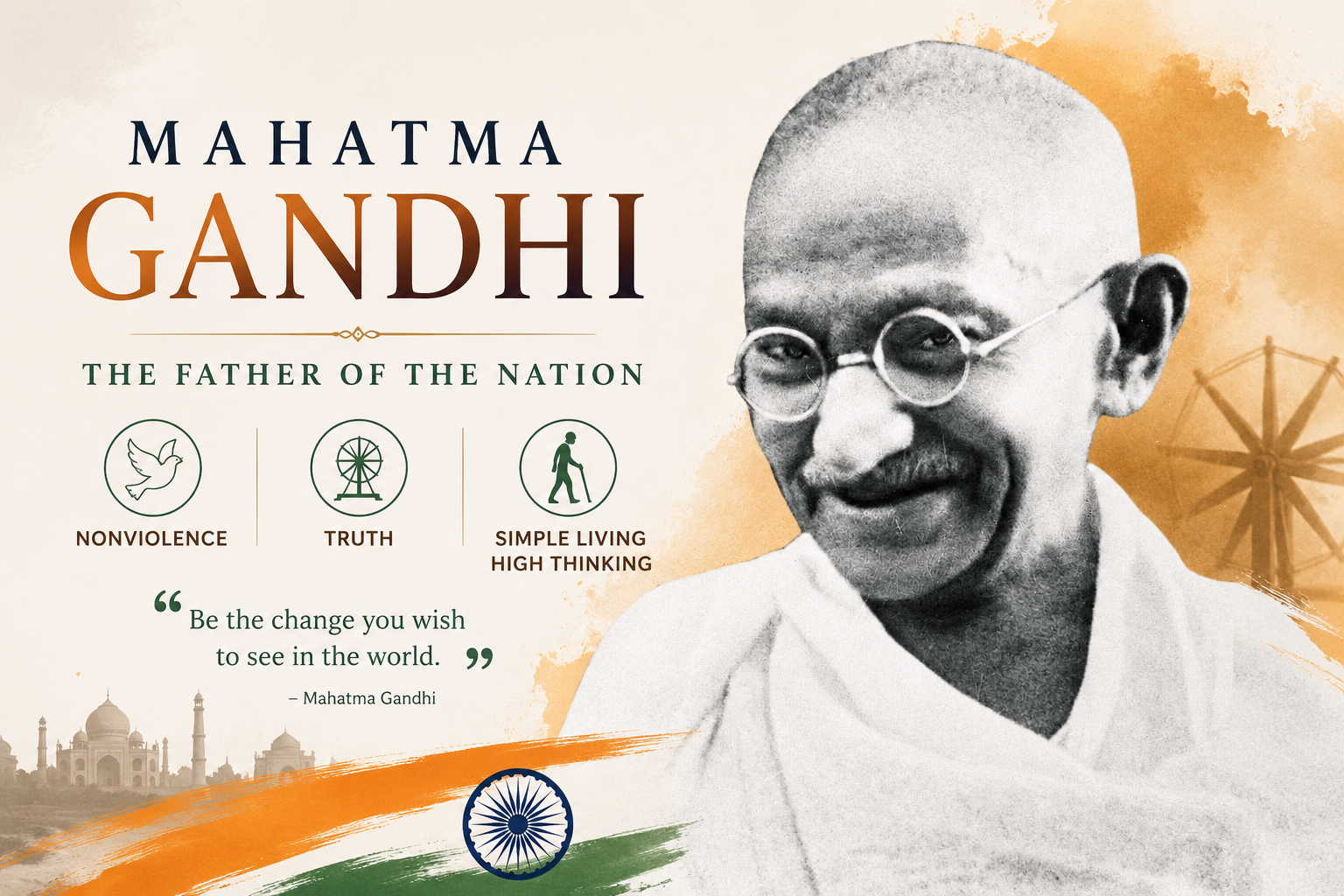
About Mahatma Gandhi
Mohandas Karamchand Gandhi lived from 1869 to 1948. Born in India, he trained as a lawyer and became a political thinker. Colonial rule repelled him. He opposed it fiercely and eventually led India’s independence movement.
Gandhi pioneered Satyagraha, the power of truth and nonviolent resistance. He put these ideals into practice during political and social upheavals. Over twenty years in South Africa shaped his thinking. That’s where he developed his tactics of nonviolent defiance. He returned to India in 1915 and launched major movements against British rule. Non-Cooperation Movement. Salt March. Quit India Movement. Each one challenged colonial domination.
In 1883 he married Kasturba Gandhi. Marriage and family life remained central to who he was. He spoke powerfully about his beliefs. His writing included Hind Swaraj, Satyagraha in South Africa, and The Story of My Experiments with Truth, his autobiography.
His vision stretched beyond political independence. Religious harmony mattered to him. Social equality. Self-reliance. Women’s rights. Ending untouchability. All of these were part of what he fought for.
Nonviolence and Satyagraha shaped movements worldwide. Civil rights activists drew from his example. Freedom struggles across the globe felt his influence. His approach changed how people thought about resistance and change.
Want more posts about him?