File Information
| Document Information | Details |
|---|---|
| Title | Gandhi: A prophet of satyagraha and nonviolence |
| Article Credit | Academia.edu |
| Author | Asmat Ullah Wazir; Jamshed Khan |
| Subject | A review of Mahatma Gandhi's philosophy of satyagraha (truth-force) and nonviolence, examining its origins, applications in South Africa and India, and its lasting influence on civil resistance movements. |
| Category | Academic review article |
| Institution | Ara Khel College Kohat; Quaid-i-Azam University Islamabad |
| Country of Publication | Not clearly stated in the document. |
| Main Topics | Gandhi's philosophy of satyagraha, Nonviolence (ahimsa) and passive resistance, Gandhi's early activism in South Africa, Rowlatt Act and Jallianwala Bagh massacre, Khilafat Movement and non-cooperation, Salt March of 1930, Gandhi's social reform for untouchables, Global legacy of Gandhi's nonviolence |
| Number of Pages | 5 |
| Language | English |
| File Type | |
| File Size | 156.9 KB |
Summary Note of this Document
This article, authored by Asmat Ullah Wazir and Jamshed Khan, reviews Mohandas Karamchand Gandhi's philosophy of satyagraha and nonviolence as a practical method of political and social resistance. The authors argue that Gandhi did not borrow his strategies from others but innovated a distinctive approach rooted in truth (satya) and firmness (agraha), distinguishing it from European passive resistance. The review traces Gandhi's biography from birth in Porbandar to his legal career in South Africa, where he first employed satyagraha against discriminatory legislation. It then discusses major Indian campaigns: the Rowlatt Act protests and Jallianwala Bagh massacre, the Khilafat Movement and non-cooperation, the 1930 Salt March, and his social reform efforts on behalf of untouchables. The article also examines the meaning of ahimsa and its religious roots in Hindu and Jain traditions, drawing on the work of scholars such as David Hardiman and Glyn Richards. Its final sections assess Gandhi's legacy, noting his influence on later leaders like Anna Hazare and movements worldwide, while acknowledging that independent India did not fully follow his principles. Overall, the paper presents Gandhi as a prophet of nonviolence whose ideas continue to inspire civil resistance globally.
Core Themes
- Satyagraha as a force of truth and love
- Ahimsa and its religious foundations
- Anti-imperial resistance and civil disobedience
- Social reform and the uplift of untouchables
- Global legacy and influence of Gandhi's ideas
Keywords
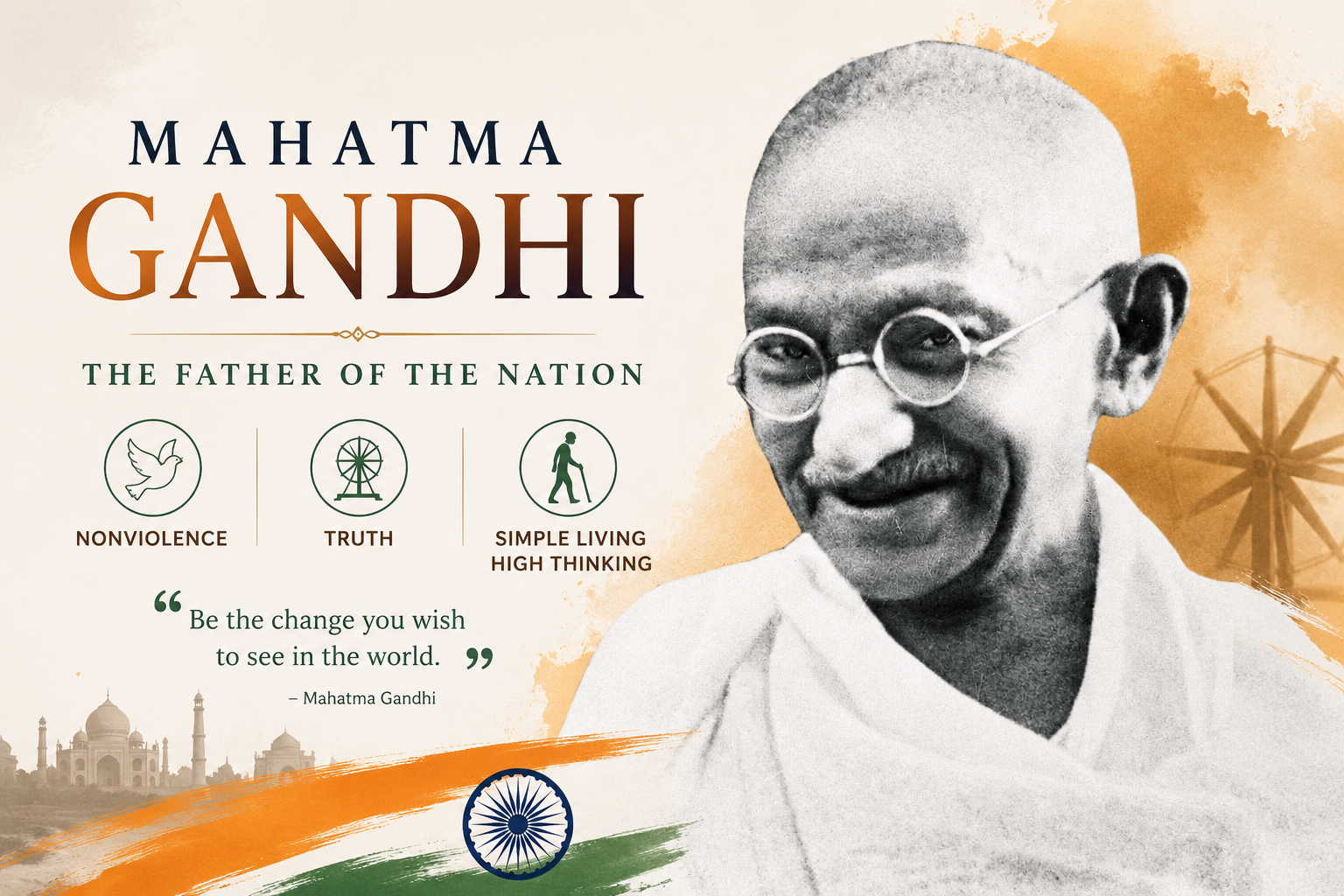
Mahatma Gandhi (1869–1948), born Mohandas Karamchand Gandhi, was an Indian lawyer, anti-colonial nationalist and political thinker who became one of the most influential leaders of India’s struggle for independence. He is particularly known for developing and applying the principles of Satyagraha, truth and nonviolent resistance in political and social movements. Gandhi spent more than two decades in South Africa, where he developed his methods of nonviolent resistance, before returning to India in 1915 and leading major movements against British rule, including the Non-Cooperation Movement, the Salt March and the Quit India Movement. He was married to Kasturba Gandhi in 1883, and their family life remained an important part of his personal history. Gandhi was also a prolific writer whose important works include Hind Swaraj, Satyagraha in South Africa, and his autobiography The Story of My Experiments with Truth. His ideas addressed not only political freedom but also religious harmony, social equality, self-reliance, poverty, women’s rights and the struggle against untouchability. His philosophy of nonviolence and Satyagraha later influenced civil-rights and freedom movements around the world.