File Information
| Document Information | Details |
|---|---|
| Title | Gandhi Ji and Satyagrah Darshan |
| Article Credit | CASIRJ, Volume 9, Issue 4 (2018), ISSN 2319-9202 (Pubd in: academia.edu) |
| Author | Prabhash Kumar |
| Subject | This article examines Mahatma Gandhi's philosophy of satyagraha and his role in the Indian freedom movement, covering his early activism in South Africa, major satyagraha campaigns, and critical evaluations by contemporaries and scholars. |
| Category | History |
| Institution | B.R.A.B.U., Muzaffarpur, Bihar |
| Country of Publication | Not clearly identified in the document. |
| Main Topics | Mahatma Gandhi's early life and South African experiences, Satyagraha: philosophy and practice of nonviolent resistance, Champaran and Kheda satyagraha, Non-cooperation Movement and its suspension after Chauri Chaura, Civil Disobedience Movement, Gandhi-Irwin Pact and Round Table Conference, Quit India Movement and the demand for independence, Gandhi-Ambedkar debate on caste and the Poona Pact, Gandhi-Tagore debates on untouchability and the Bihar earthquake |
| Number of Pages | 6 |
| Language | English |
| File Type | |
| File Size | 243.5 KB |
Summary Note of this Document
Prabhash Kumar's article 'Gandhi Ji and Satyagrah Darshan' provides a historical survey of Mohandas Karamchand Gandhi's political philosophy and his distinctive method of nonviolent resistance, satyagraha. It traces Gandhi's upbringing in Porbandar, his legal studies in London, and the racial humiliations he endured in South Africa that awakened his social activism. Drawing on Gandhi's own writings and the assessments of historians such as R.C. Majumdar, Ram Gopal, and R. Palme Dutt, the article examines major campaigns including the Champaran and Kheda satyagrahas, the All India Satyagraha against the Rowlatt Act, the Non-cooperation Movement, the Civil Disobedience Movement, and the Quit India Movement. It also discusses Gandhi's controversial positions: his support for British war recruitment despite his nonviolence, his proposal regarding Jinnah after Pakistan's creation, and his refusal to endorse the separate electorate for Harijans, leading to the Poona Pact with Ambedkar. The article highlights Gandhi's emphasis on love, self-purification, and truth as the core of satyagraha, alongside critical perspectives on his legacy from Ambedkar and Tagore. The paper ultimately presents Gandhi's life achievement as the invention and application of a humane, nonviolent means for national liberation.
Core Themes
- Satyagraha as soul-force and nonviolent resistance
- Gandhi's transformation from colonial loyalist to nationalist leader
- Major mass movements in India's freedom struggle
- Debates over Gandhi's political and moral choices
- Caste, untouchability, and communal unity in Gandhi's vision
Keywords
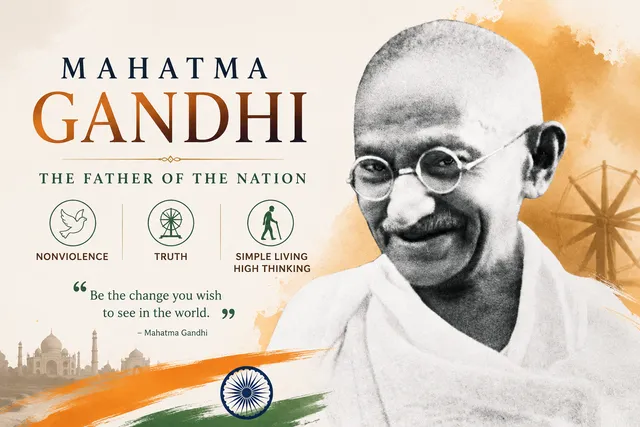
About Mahatma Gandhi
Mohandas Karamchand Gandhi lived from 1869 to 1948. Born in India, he trained as a lawyer and became a political thinker. Colonial rule repelled him. He opposed it fiercely and eventually led India’s independence movement.
Gandhi pioneered Satyagraha, the power of truth and nonviolent resistance. He put these ideals into practice during political and social upheavals. Over twenty years in South Africa shaped his thinking. That’s where he developed his tactics of nonviolent defiance. He returned to India in 1915 and launched major movements against British rule. Non-Cooperation Movement. Salt March. Quit India Movement. Each one challenged colonial domination.
In 1883 he married Kasturba Gandhi. Marriage and family life remained central to who he was. He spoke powerfully about his beliefs. His writing included Hind Swaraj, Satyagraha in South Africa, and The Story of My Experiments with Truth, his autobiography.
His vision stretched beyond political independence. Religious harmony mattered to him. Social equality. Self-reliance. Women’s rights. Ending untouchability. All of these were part of what he fought for.
Nonviolence and Satyagraha shaped movements worldwide. Civil rights activists drew from his example. Freedom struggles across the globe felt his influence. His approach changed how people thought about resistance and change.