By Reji Sankar
Introduction: Nalanda — A Beacon of Indian Knowledge
The history of Nalanda University, once the greatest lighthouse of Indian knowledge, is a story of brilliance, survival, and eventual destruction. Long before the infamous 12th-century attack by Bakhtiyar Khilji, Nalanda had already faced a major political and religious crisis in the 7th century CE. At the heart of this conflict was the struggle between Shashanka, the ruler of Gauda (Bengal), and Harshavardhana, the king of Kannauj.
Shashanka and the First Major Crisis of Nalanda
In the early 7th century CE, Shashanka, a powerful king ruling the Gauda kingdom centered in Bengal, emerged as a dominant political force. A devout Shaivite, Shashanka viewed the growing influence of Buddhism in North India not merely as a religious challenge but as a political threat.
According to the records of the Chinese traveler Xuanzang (Hiuen Tsang), Shashanka was a fierce opponent of Buddhism. Historical sources indicate that he attempted to cut down the Bodhi Tree at Gaya, where the Buddha attained enlightenment, and sought to destroy Buddhist monasteries, including those around Nalanda. These actions were not only driven by religious hostility but were also part of a broader political strategy to weaken neighboring Buddhist-supported kingdoms.
Who Attacked Nalanda First? Was There a Brahmin Role?
A turning point came when Shashanka deceitfully assassinated Rajyavardhana, the brother of Harshavardhana. Determined to avenge his brother’s death and stop Shashanka’s expansion, Harshavardhana formed an alliance with Bhaskaravarman, the king of Kamarupa (Assam). This alliance placed Shashanka under pressure from both east and west.
Prolonged wars followed between Harsha and Shashanka. Although Shashanka remained militarily strong during his lifetime, preventing Harsha from fully conquering Gauda, Nalanda and its surrounding regions suffered severe instability. Military movements disrupted monastic life, forcing many monks to flee. While Harsha could not decisively defeat Shashanka, he did manage to curb the latter’s persecution of Buddhists.
Revival of Nalanda under Harshavardhana
The conflict ended with Shashanka’s death around 637 CE. Though Nalanda had been weakened, it was not destroyed. After Harshavardhana consolidated power over Magadha and parts of Bengal, Nalanda experienced a remarkable revival.
Harshavardhana became one of Nalanda’s greatest patrons. He rebuilt the university, allocated revenues from nearly 100 villages for its daily expenses, and provided full royal protection. When Xuanzang arrived to study at Nalanda, it had already become the world’s leading center of learning once again.
Historical Evidence Against Shashanka
Xuanzang’s writings describe Shashanka’s actions in detail:
-
Attempted destruction of the Bodhi Tree
-
Demolition of monasteries in Kushinagar and Pataliputra
-
Expulsion of Buddhist monks from regions around Nalanda
-
A climate of fear that shattered the peaceful academic environment
Another important source is the Manjushree Moolakalpa, a Sanskrit Buddhist text (8th–9th century), which refers to Shashanka as “Soma” and documents large-scale persecution of Buddhists. Though religious in nature, it contains valuable historical clues.
The 16th-century Tibetan historian Taranatha, in History of Buddhism in India, also records Shashanka’s destruction of monasteries and forced displacement of monks.
Among all sources, Xuanzang’s eyewitness-based accounts remain the most credible historical evidence.
The Final Blow: Bakhtiyar Khilji (1193 CE)
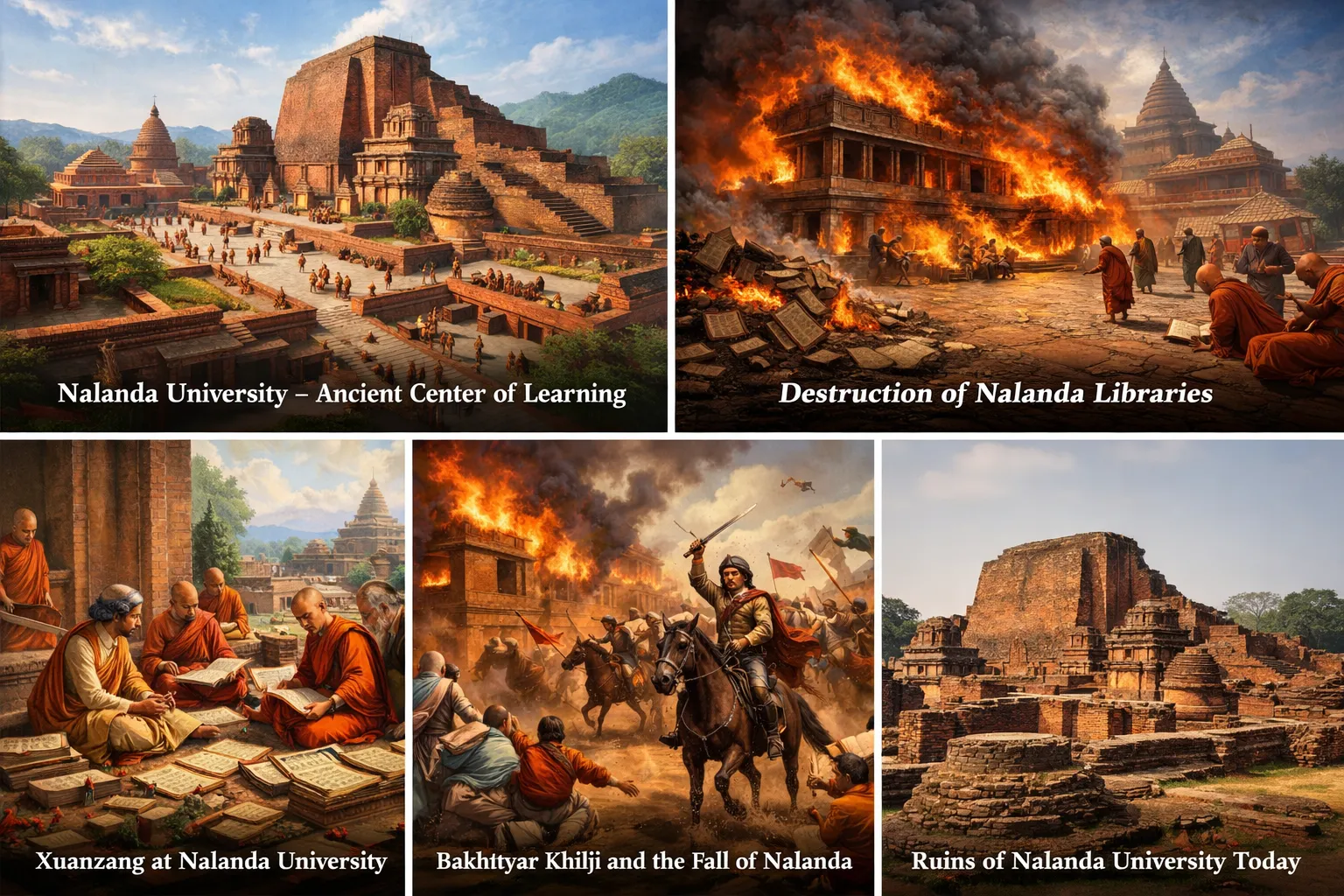
The darkest chapter in Nalanda’s history occurred in 1193 CE, when Bakhtiyar Khilji led a Turkic military invasion. According to Minhaj-i-Siraj’s Tabaqat-i-Nasiri, Khilji attacked Nalanda after mistakenly believing it to be a fortified military complex. Seeing monks dressed like soldiers reinforced this misunderstanding.
Some Tibetan traditions suggest that even within Khilji’s army, debates arose—arguing that killing unarmed scholars and burning libraries was dishonorable. Nevertheless, the attack went ahead.
Internal Factors and Religious Hostility
Tibetan historian Lama Taranatha points to intense hostility between Buddhist and Brahminical sects during this period. Some studies suggest:
-
Certain local Brahmin groups hostile to Buddhism may have provided intelligence to Khilji’s forces.
-
After partial restoration, two Brahmin youths allegedly burned Nalanda’s libraries in an act of revenge—likely symbolic but reflective of deep religious animosity.
-
After the Pala dynasty, the Sena rulers, strong supporters of Brahminism, reduced royal patronage to Buddhist institutions, making Nalanda vulnerable.
Nalanda’s libraries, which reportedly housed over 1.2 million manuscripts, burned for months—an irreparable loss to world civilization.
Eyewitness Account After the Destruction: Dharmasvamin
The most reliable post-destruction account comes from the Tibetan monk Dharmasvamin (Chag Lo-tsa-ba), who visited Nalanda in 1234 CE, about 40 years after Khilji’s attack.
He found Nalanda in ruins—its great buildings destroyed, resembling a graveyard. Yet, around 200 monks were still attempting to study among the debris. Dharmasvamin met Rahul Shribhadra, a 90-year-old scholar and Nalanda’s last great teacher, who continued teaching despite constant danger.
During Dharmasvamin’s stay:
-
A fresh Turkish military threat forced most monks to flee
-
Rahul Shribhadra, unable to walk, was carried to safety by Dharmasvamin himself
-
Libraries were completely burned; only fragments of knowledge remained
A local ruler named King Gunashila, though not a Buddhist, supported Rahul Shribhadra out of respect for learning. Villagers also helped monks hide during attacks, reflecting grassroots humanity despite elite hostility.
Dharmasvamin noted that Nalanda’s failure to revive was due primarily to lack of financial support, not instant annihilation.
Rethinking the Narrative of Buddhism’s Decline in India
Historical records clearly show that Islamic invasions alone did not destroy Buddhism in India. The claim that Islam single-handedly eliminated Buddhism is historically inaccurate.
Hundreds of Buddhist monasteries across the Indian subcontinent were destroyed or taken over before or independent of Islamic rule, and many of these sites later became Hindu temples. If Islam alone had wiped out Buddhism, this transformation would be impossible to explain.
The decline of Buddhism resulted from a combination of factors:
-
Loss of royal patronage
-
Internal religious hostility
-
Political manipulation
-
External invasions
-
Gradual institutional decay
Conclusion
Nalanda did not fall in a single day. It endured centuries of pressure, survived early political-religious persecution under Shashanka, revived under Harshavardhana, and finally succumbed to a lethal mix of foreign invasion and internal religious antagonism.
The tragedy of Nalanda is not just the loss of buildings or manuscripts—it is the story of how a great civilization’s intellectual heart slowly stopped beating.