Mufti Shamail Nadwi: A Brief Biography Amidst the Echoes of a Fiery Debate
A few days ago in India, a heated debate took place between Mufti Shamail Nadwi and the renowned atheist Javed Akhtar on the topic "Does God Exist?" This debate sparked widespread resonance in India and became a major point of discussion in the Islamic world, where it was translated into Arabic and English, leading to its broad dissemination. As a result, numerous intensive inquiries arose about the persona of Mufti Shamail Nadwi, with many asking about his biography. For this reason, I present here a concise overview of his life and background.
Adapted from: Ahmed Al-Balushi (may God preserve him)
Early Life and Education
Mufti Shamail Ahmed Abdullah Nadwi (commonly known as Mufti Shamail Nadwi) is an Indian Islamic scholar, educator, preacher, and public speaker. He was born on June 7, 1998, in India, and grew up in Kolkata, West Bengal, in a religious environment. In one of his audio interviews (podcast), Mufti Shamail mentioned that his father is a devout man, likely from a scholarly background, and an active member of the Tablighi Jamaat.
He was raised in a family that balanced modern education with traditional Islamic learning. After completing the eighth grade, he enrolled in the Shar'iyyah (Islamic jurisprudence) track at Darul Uloom Nadwatul Ulama in Lucknow, one of India's most prominent Islamic seminaries, where he studied Qur'anic sciences, Hadith, Fiqh, and then completed a specialized course in Iftaa (fatwa training), earning the title of Mufti.
Initiatives and Institutions
After graduation, greatly influenced by the works of the eminent scholar Abu al-Hasan Ali Nadwi in confronting Western ideologies, he joined his sheikh, Maulana Mufti Yasser Nadeem Al-Wajidi Al-Deobandi (Ash'ari-Maturidi), and studied under him for two years in the course "Tuhfat al-Mulhideen" (A Gift to the Atheists). Following this training, he began his da'wah (propagation) activities through digital platforms, debating and refuting atheists, polytheists, Hindus, Christians, and others holding ideologies opposing Islam.
He also traveled abroad to continue his studies, and it is noted that he is pursuing a PhD in Islamic Studies in Malaysia.
Mufti Shamail Nadwi founded Markaz al-Wahyain (Center of the Two Revelations), an online Islamic educational institution offering courses in Qur'an, Hadith, Fiqh, and other religious sciences, aimed at providing systematic Islamic education on a global scale. He is also affiliated with the Wahyain Foundation, a charitable organization focused on Islamic education and community service.
He maintains a significant digital presence on YouTube and social media, delivering lectures, answering questions, and addressing contemporary issues facing Muslims.
The Famous Debate
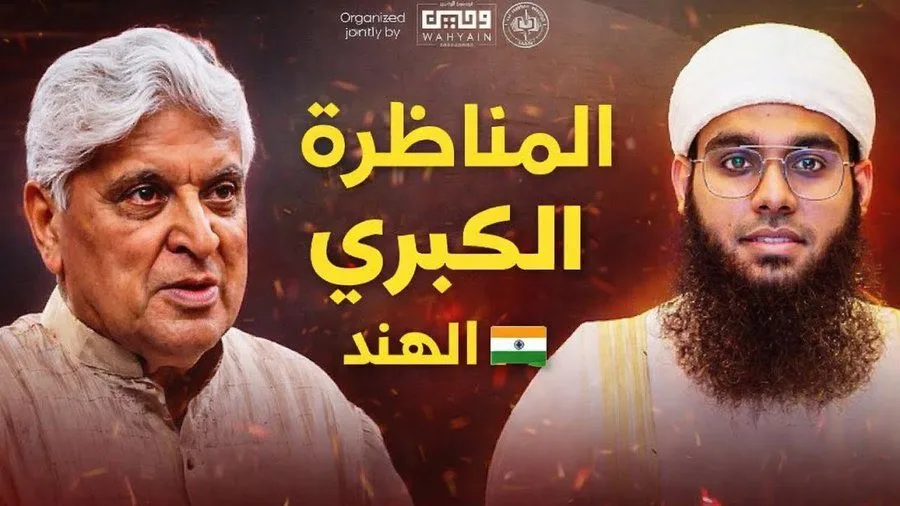
In December 2025, Mufti Shamail Nadwi garnered widespread attention for his participation in a public debate titled "Does God Exist?" with the Indian poet and thinker Javed Akhtar, under the supervision and guidance of his sheikh, Mufti Yasser Nadeem Al-Wajidi. The debate was grounded in Ilm al-Kalam (Islamic theology) and drew its arguments from the commentary on Al-'Aqaid al-Nasafiyyah, as explicitly stated by both Mufti Shamail and his sheikh. Indian media covered the debate extensively, and it spread widely across digital platforms.
|
| Poster for the Great Indian Debate: Sheikh Mufti Shamail Nadwi (right) faces off against the atheist Javed Akhtar (left) under the title "Does God Exist?" |
Additional Contents for This Article
In the wake of this famous debate, a broad controversy unfolded in the Arab world regarding the persona of Sheikh Mufti Shamail Nadwi, followed by various writings and responses. Below are some of the most important of these writings.
By: Sheikh Furqan Usmani Al-Hanafi Al-Deobandi
Regarding Attributing Mufti Shamail Abdullah Nadwi to Contemporary Salafism
There is nothing explicit or clear in this matter. The sheikh has never declared affiliation with any specific group, neither Ash'arism nor Salafism. As for Nadwatul Ulama, his alma mater, it is known for its leniency in matters of creed, meaning it does not place great emphasis on subtle theological disputes and does not teach books of Kalam in a systematic manner.
However, one thing is abundantly clear: Mufti Shamail is not Salafi in creed, even though he follows the methodology of the righteous predecessors (Salaf al-Salih).
There are several pieces of evidence for this:
- His close ties to Deobandi Ash'ari and Maturidi scholars, without considering them innovators.
- Completing a two-year scholarly course titled "Tuhfat al-Mulhideen" under his sheikh, Mufti Yasser Nadeem Al-Wajidi, a graduate of Darul Uloom Deoband from a venerable Deobandi scholarly family.
- His explicit statement, when asked about the role of Kalam in his debate with Javed Akhtar, affirming that the entire debate was based on Ilm al-Kalam.
- Deriving his arguments from the commentary on Al-'Aqaid al-Nasafiyyah by Imam al-Taftazani, as mentioned by Mufti Yasser Nadeem Al-Wajidi in an event held after the debate at Darul Uloom Deoband.
- Anyone with even basic knowledge of Salafi creed would recognize from that debate that the sheikh does not adhere to it, for numerous reasons, including:
- Relying on the proof of huduth (temporality), based on absolute non-existence followed by creation from non-existence by the Necessary Existent, which contradicts the Salafi belief that the world has no absolute beginning and that the genus of incidents is eternal.
- Repeatedly denying time and place from God Almighty during the debate.
- Denying that God has a sensory existence perceivable by the senses.
- Describing God's essence as "qadim" (eternal/pre-eternal), which Salafis consider contrary to their creed, as Ibn Abi al-'Izz deemed this terminology an innovation of the theologians in his commentary on Al-Tahawiyyah.
- Describing God Almighty as a "metaphysical existence," which is one of the clearest indicators that he is not on Salafi creed; metaphysical existence is defined as that which is:
- Non-material
- Not subject to time and place
- Not perceivable by the senses
- Not constrained by physical or material attributes
|
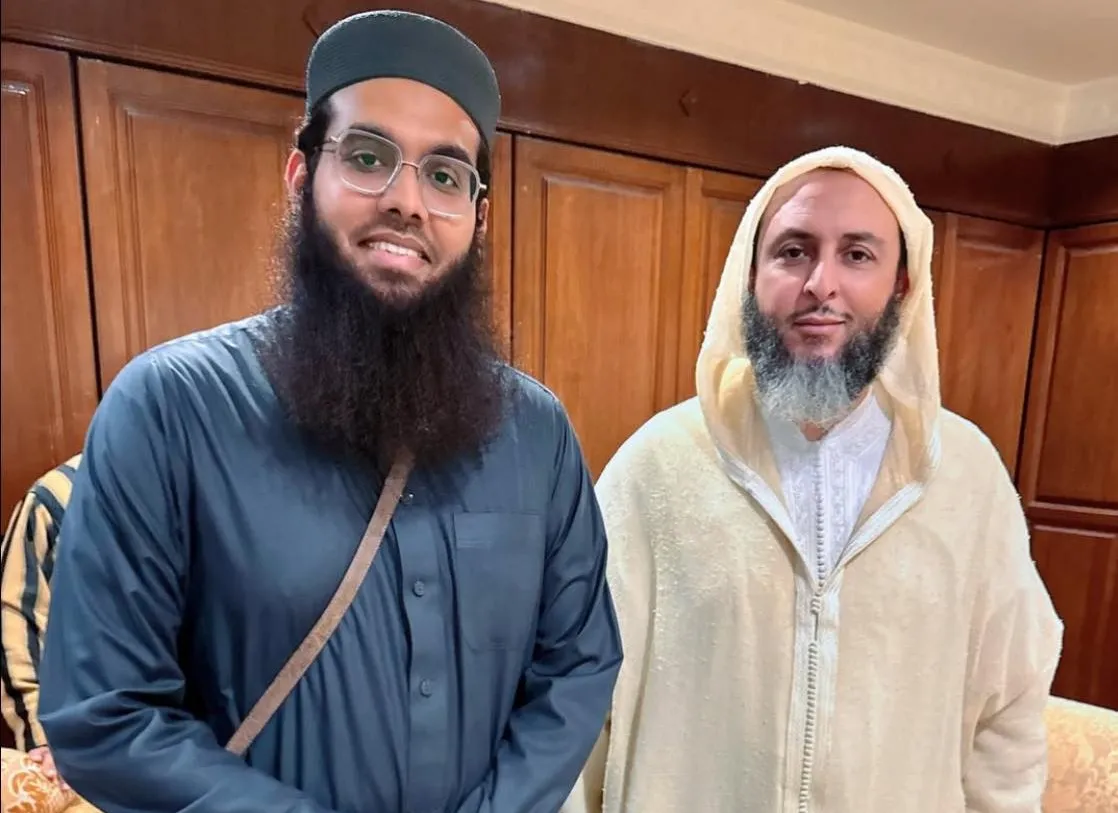
| Sheikh Shamail Nadwi (left) and the Moroccan scholar Sheikh Dr. Saeed al-Kamali (right) in a joint meeting. |
Objection:
The only evidence some Salafis rely on to claim the sheikh is Salafi is a screenshot from a Q&A story where he answered the question "Where is God?" with the verse:
The Most Merciful [who is] above the Throne established. (Qur'an 20:5)
Response:
Anyone with even basic knowledge of Ash'ari creed cannot make such a claim. Our imams never denied this verse; rather, they affirmed it while negating modality, direction, place, and movement from God's essence.
This is the madhhab (school) of Imam Abu al-Hasan al-Ash'ari (may God have mercy on him), as he explicitly stated in Al-Ibana:
"That God Almighty is established above the Throne in the manner He has said and in the sense He intended, an establishment free from contact, settlement, entrenchment, indwelling, and translocation. The Throne does not carry Him; rather, the Throne and its bearers are carried by the subtlety of His power and subdued in His grasp. He is above the Throne and above everything, to the extremities of the earth, an aboveness that does not bring Him closer to the Throne or the heaven; rather, He is exalted in degrees above the Throne, just as He is exalted above the earth. Yet with that, He is near to every existent, closer to the servant than the jugular vein, and He is Witness over everything."
In exactly this manner, the sheikh affirmed God's exaltedness while negating all corrupt implications.
If this answer made him "Salafi," then what about his affirmation of the verse:
And He is with you wherever you are. (Qur'an 57:4)
When asked "Where is God?" (May 23, 2021)? Would that—God forbid—make him a Jahmi heretic?!
Conclusion:
Thus, Mufti Shamail Abdullah Nadwi—praise be to God—is upon the creed of Ahl al-Sunnah wa al-Jama'ah, following the righteous predecessors, adhering to the Ash'ari-Maturidi methodology. And God knows best.
We ask God Almighty to guide us to the straight path, to preserve Mufti Shamail upon the truth, and to make him firm upon it.
Sheikh Ahmed Al-Balushi Writes on This Issue
Even assuming, for the sake of argument, that Mufti Shamail Nadwi holds a Salafi creed—hypothetically—he employed the method of the theologians in the debate and followed the Qasimi wisdom approach in argumentation.
Indeed, Sheikh Shamail prepared for three days before the debate with Sheikh Mufti Yasser Nadeem Al-Wajidi Al-Qasimi Al-Deobandi, a Hanafi Maturidi Deobandi who frequently responds to contemporary atheists and is well-versed in Qasimi philosophy (attributed to Imam Muhammad Qasim Nanotawi, may God have mercy on him, founder of Darul Uloom Deoband).
Mufti Shamail Nadwi's Response After His Debate with the Indian Atheist Javed Akhtar, and in the Wake of the Controversy in the Arab World: Is He Salafi or Not?