
| Title | Mahatma Gandhi: A Revolutionary Transformer |
|---|---|
| Author | Khushboo Sain |
| Category | studies about mahatma gandhi |
| Number of Pages | 3 |
| Language | English |
| File Size | 78. KB |
| File Type | |
| Country of Publication | India |
| Main Topics | Introduction, Revolutionary Transformation in Management, Self- Management, .time Management, Wealth Management, .resource Management, Stress Management, Emotional Intelligence, Communication, Turnaround Specialis, Conclusion, References |
Summary Note of this Document
This three-page research paper by Khushboo Sain, a Research Scholar at the University of Rajasthan, Jaipur, India, published in the International Journal of Scientific and Research Publications (Volume 7, Issue 7, July 2017), portrays Mahatma Gandhi as a "Revolutionary Transformer" in management. It mainly focuses on how Gandhi's peaceful and non-violent (Ahimsa) principles of life based on truth (Satya), simplicity, humanity, and unity—taken from movements like Satyagraha, Non-Cooperation Movement, Dandi March and Quit India Movement—can be used in business and corporate management of the present day. Love, trust, and human goodness are the roots of Gandhi's philosophy, and the paper argues that it opens up new ethical leadership and organizational practice dimensions.
Key Sections:
The section of revolutionary transformation in management:
Deal with Gandhi's mastery of various management branches:
Time Management:
Among many other things, Gandhi was very punctual (e.g., carrying a dollar-watch), he answered every letter without delay, and he made good use of his spare time even when he was at the infirmary.
Wealth Management:
It is founded on the Doctrine of Trusteeship according to which the surplus wealth is the heritage of the society; connects to the contemporary Corporate Social Responsibility (CSR), which is a promoter of equity between capital and labor without giving way to exploitation.
Resource Management:
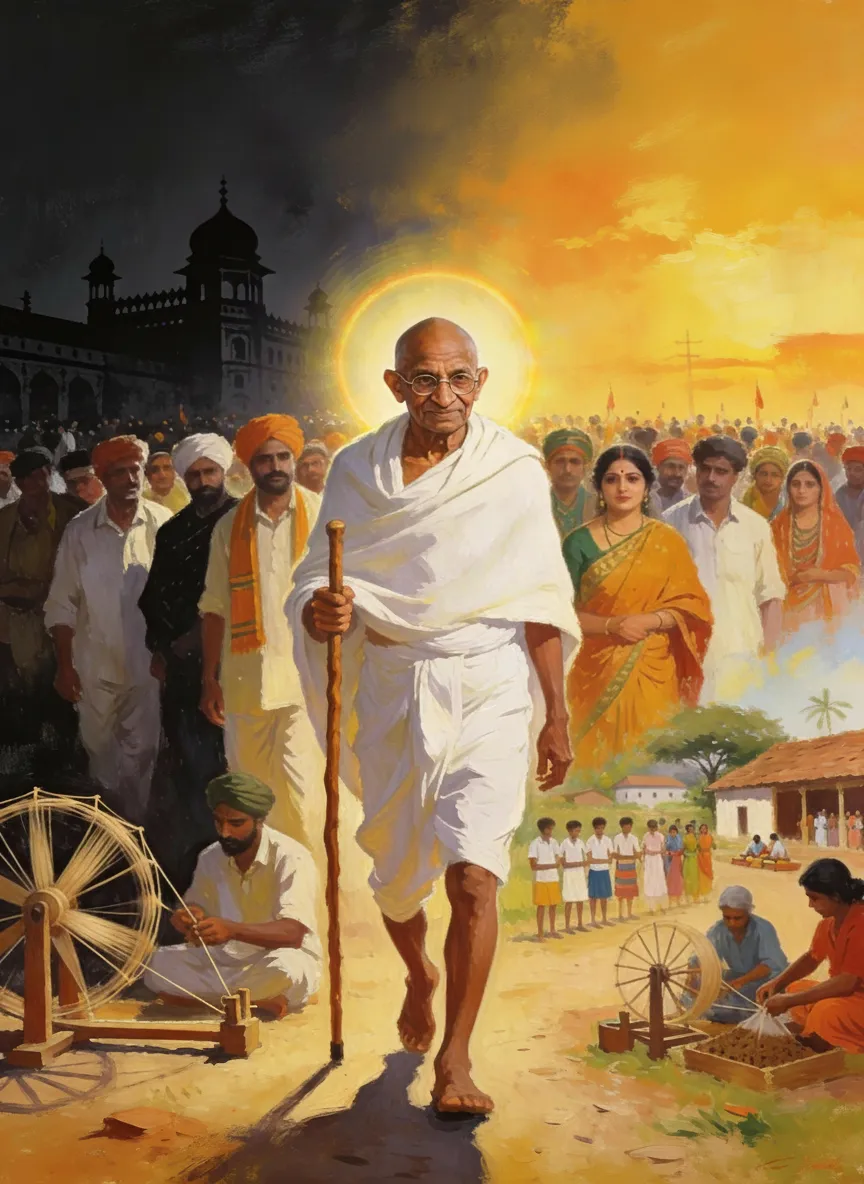
Through his Khadi (handspun cloth) and Swadeshi advocacy, Gandhi not only revived Indian textiles but also solved the unemployment problem and at the same time, he exploited the resources in a labor-friendly way.
Stress Management:
Among ways for him to keep physically, mentally, spiritually fit were: use of humor, reading of the Bhagavad Gita, practice of yoga (asanas, pranayama, meditation), non-violence; he suggests the present-day yoga classes for workers as a way to handle stress.
Emotional Intelligence:
Gandhi's had very high EQ, and he was able to identify the emotions, motivate himself, handle relationships, negotiation, and perseverance (e.g., "Patience and perseverance can conquer mountains").
|
Communication:
Even though Hindi was not his native language, through great-theory-and-practice activities such as speeches and negotiations, Gandhi united India leading to milestones like India's independence in 1947.
Turnaround Specialist:
Claims Gandhi was one of those leaders who brought back India's power, got rid of British rule, and elevated the country, much like modern corporate turnaround professionals.
Conclusion:
The first motive of the paper is to propose the incorporation of Gandhian principles into corporations so that they might create ethical environments. Apart from that, labor conflicts can be resolved through the trusteeship method, the use of CSR, self-discipline, and leading by example. Besides, it praises Gandhi as a "Management Guru" whose thoughts are the surest ways to success through moralistic, spiritual, and equitable practices.
Aside from that, the research adds to the conclusion a list of references, for example, the Bombay Sarvodaya Mandal, R Venkateswarlu, B. Ram Mohan Rao, Nina Martyris, Mani Bhavan, Dr. Nanduri Aparna Rao, C.S. Dharmadhikari, Bal Patil, Mukul Chaudhri, Suresh Kr Pramar, and Shekhar Kapoor. In the final analysis, it is all about Gandhi's unwavering impact on the world, changing management to a non-competitive yet humane approach, and being relevant even today.