 |
| Search document — A representative image. |
File Information
| Document Information | Details |
|---|---|
| Title | Search document |
| Subject | The available PDF text does not provide readable content beyond a title-page fragment, so the document's subject is not clearly stated. |
| Category | Unknown |
| Number of Pages | 1 |
| Language | English |
| File Type | |
| File Size | 6.28 MB |
Summary Note of this Document
Search document
Search document is the only readable text available from this PDF, so its actual subject cannot be identified from the supplied page image alone. The file shows a page counter and the History Marg website address, but no article title, author line, abstract, body text, or publication details are visible in the extracted text. Because of that, there is no reliable basis for assigning a topic, historical argument, or date. The document may belong to the Malabar rebellion and Khilafat archive described in the batch instructions, yet the text supplied here does not confirm that connection. Any stronger identification would require additional pages or a clearer text extraction. At present, the most accurate description is simply that the PDF text is not readable enough to recover bibliographic metadata or substantive content. The visible material does indicate that the file comes from historymarg.com, but nothing more specific can be verified from the supplied text.
Core Themes
- Not clearly stated in the document.
Keywords
Malabar Rebellion
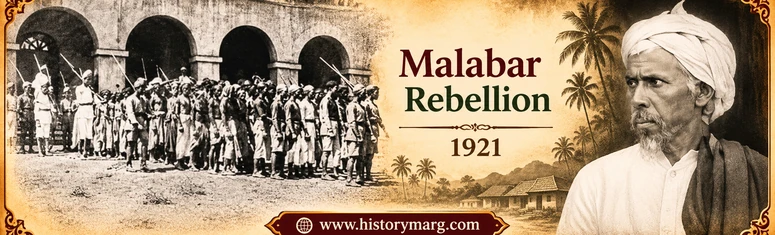
The Malabar Rebellion (sometimes referred to as the Moplah or Mappila Rebellion) arose as a form of protest to British colonialism in the southern area of the former Malabar region (now the state of Kerala). Typically, it has been associated with the Khilafat Movement which was brought to Malabar at a conference in Manjeri in April 1920. In addition, it is connected to the national movement for independence. However, largely it was a peasant-led protest for Mappila Muslims against colonialism. There had already been a tradition of agrarian unrest in the area. Land was owned by Jenmi landlords who were predominantly either Namboothiri Brahmins or Nairs and tenants therefore endured high levels of rent, as well as a lack of security and payment of land revenue.
In August 1921 the rebellion commenced. Police on 20th August stormed a Mosque in Tirurangadi called Mambaram and detained Khilafat activists. Rumours then circulated that the Mosque had been vandalised. Subsequently, a big group of people surrounded the local police station. Shots were fired by the police and soon afterwards the rebellion spread to cover Eranad and Valluvanad taluks. People attacked police stations, courts, treasuries, telegraph and postal systems together with railway stations. In certain areas self government was established. Prominent rebel leaders included Ali Musliyar and Variyankunnath Kunjahammad Haji. Furthermore, some Hindus were also recognised as leading members of the rebellion including Mozhikunnath Brahmadathan Nambudiripad. These people too were subsequently detained.
British forces were deployed and martial law was imposed. For approximately six months the rebellion encompassed an area of about 2000 square miles – some 40 per cent of South Malabar. Approximately 100 detainees were transported in a sealed goods wagon, by train, from Tirur to Coimbatore on 10th November 1921. Sadly, 64 people died from suffocation in this incident, known as the Wagon Tragedy. Around 2300 rebels are officially recorded as having been killed and in excess of 45,000 detained. However, unofficially, often around 10,000 deaths are suggested. Furthermore, numerous rebel leaders received death sentences. Thousands were also exiled, predominantly to the Andaman Islands.
Commentary
There continues to be differing interpretations of the Malabar Rebellion. Some emphasise its nationalist and anti-feudal nature and relate this to both land related issues and the Khilafat Movement. However, others highlight the communal nature of the rebellion and point specifically to inter-communal conflict, assault on Hindu landlords and allegations of Hindu to Muslim conversion pressure. Disputes continue regarding both the extent and nature of the communal violence. Again, both these viewpoints are presented within source material. To this day there is debate as to what should be the legacy of the rebellion. Significantly, in 2021 there was heated discussion surrounding a suggestion that the Malabar rebels should be omitted from the Dictionary of Martyrs of India's Freedom Struggle due to its communal nature.