 |
| The Origins of the Non-Cooperation Movement: A Khilafat Initiative Appropriated by Gandhi — A representative image. |
File Information
| Document Information | Details |
|---|---|
| Title | The Origins of the Non-Cooperation Movement: A Khilafat Initiative Appropriated by Gandhi |
| Article Credit | International Journal of Humanities Social Science and Management (IJHSSM), ISSN: 3048-6874, Vol.: 5, Issue: 5, Year: 2025, (Pubd in: Academia.edu) |
| Author | Dr Nilanjan De (Assistant Professor (SL Gr), Department of History, Rabindrasadan Girls' College, Sribhumi, Assam) |
| Subject | Gandhi's support for the Khilafat leaders, his ties with the Ali brothers and the question of whether the Khilafat-Non-Cooperation alliance was really about Swaraj. |
| Category | Khilafat Movement |
| Institution | Rabindrasadan Girls' College, Assam |
| Country of Publication | India |
| Main Topics | Collapse of the Ottoman Empire and Indian Muslim fears, Gandhi and the Ali brothers, Gandhi's support for British recruitment in the First World War, From the Balkan Wars to the Treaty of Sèvres, Whether the alliance was about Swaraj |
| Number of Pages | 11 |
| Language | English |
| File Type | |
| File Size | 331.9 KB |
Summary Note of this Document
The Origins of the Non-Cooperation Movement: A Khilafat Initiative Appropriated by Gandhi
Dr Nilanjan De calls the Khilafat Movement a key yet complicated part of India's fight for freedom, mixing religious feeling, political goals and the changing role of leaders in resisting British rule. In the abstract the movement begins with the collapse of the Ottoman Empire after the First World War, which worried Indian Muslims about losing the Caliph, their spiritual leader. Leaders such as the Ali brothers, Abul Kalam Azad and Hakim Ajmal Khan led it, and it soon merged with growing anti-British feeling. Gandhi's decision to back the Khilafat leaders, supposedly to boost the Non-Cooperation Movement and unite Hindus and Muslims, is still debated by historians. The paper reads his letters, speeches and actions as a mix of loyalty to the British Empire, efforts to win over Muslim leaders and clever moves to strengthen his own position. It studies his ties with the Ali brothers, his push to free them and his surprising support for British recruitment during the war, and it asks how a religious movement was turned into a national one. By tracing the Khilafat issue from the Balkan Wars to the Treaty of Sèvres, the study questions whether the alliance really aimed at Swaraj or was a smart use of Muslim concerns. It was submitted on 28 September 2025, accepted on 8 October 2025 and published in IJHSSM, volume 5, issue 5, pages 462 to 472.
Core Themes
- Khilafat as the origin of non-cooperation
- Gandhi's relations with the Ali brothers
- Loyalty and strategy in Gandhi's letters
- Religious movement turned national
- Swaraj and Muslim concerns
Keywords
About the Khilafat Movement in India
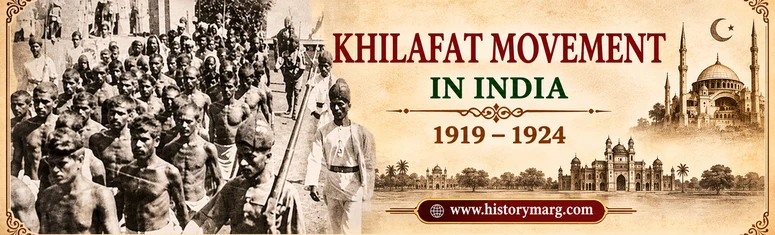
From 1919 to 1922, there was a political campaign by the Muslims of British India, known as the Khilafat Movement, in opposition to the British Indian policies about Turkey and the dismemberment of the Ottoman Empire after the end of the First World War. The Ottoman sultan was also the caliph or religious head of Sunni Muslims globally and many Indian Muslims became concerned for the caliphate as the Allied forces moved against Turkey. Through the Treaty of Sèvres (1920), lands like Palestine, Syria, Lebanon, and Iraq were taken from the empire. While there were protests throughout the Muslim world, the most intense were in India.
Among the leaders were Maulana Mohammad Ali Jauhar, Maulana Shaukat Ali, Hakim Ajmal Khan, Maulana Abul Kalam Azad, Dr. M. A. Ansari and Hasrat Mohani. They set up an All India Khilafat Committee in Lucknow and in 1920 released a Khilafat Manifesto, which urged the British to safeguard the Khilafat. The same year the leaders of the Khilafat Movement allied themselves with the Indian National Congress. Mahatma Gandhi and the leaders of the Khilafat Movement made a pact to work together for the Khilafat cause and for Swaraj. The leaders of Congress like Vallabhbhai Patel and Bal Gangadhar Tilak also gave their support.
The Khilafatists also joined in on the Non-Cooperation Movement, which was a mass non-violent civil disobedience nationwide campaign, which began with a boycott of the legislative councils, government schools and colleges, foreign goods and government functions with the surrender of titles. Gandhi and the Ali brothers were then arrested. Some individuals from the North-West Frontier Province embarked on a protest emigration to Afghanistan, and Indians contributed funds, including one to the Ankara government of Mustafa Kemal. The movement came to an end in 1922 when the Non-Cooperation movement ended. Turkey's secular republic then abolished the caliphate itself in 1924.
From 1919 to 1922, there was what is perhaps seen as the apogee of Hindu-Muslim unity. In India, the period of the movement is identified as an era of the height in the history of civil disobedience, though some questioned if a campaign centered around the Ottoman caliphate might suit a movement for the unity of India. After the movement declined, the leadership was divided. Ata Ullah Shah Bukhari would later establish the Majlis-e-Ahrar-e-Islam, Dr Ansari, Azad, and Hakim Ajmal Khan remained with Gandhi and the Congress, and the Ali brothers entered the Muslim League. Jinnah quit the Congress once his admonitions about the hazards of integrating the caliphate cause with the nationalist movement were ignored.
Complete Khilafat Movement Research Collection
Download the Complete Collection of Khilafat Movement Research PDFs Available on HISTORY MARG