 |
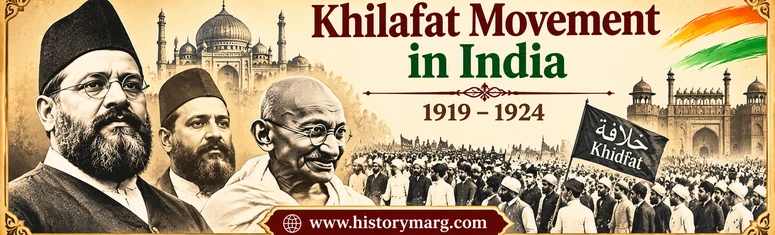
| Khilafat Movement: A Catalyst for Greater Unity Among Muslims — A representative image. |
File Information
| Document Information | Details |
|---|---|
| Title | KHILAFAT MOVEMENT: AS A CATALYST FOR GREATER UNITY AMONG MUSLIMS |
| Article Credit | International Journal of Social Sciences Bulletin, ISSN: 3007-1917 (Online); 3007-1909 (Print), Vol.: 2, Issue: 4, Year: 2024, (Pubd in: ResearchGate) |
| Author | Salahuddin Abro (Lecturer, Department of Pakistan Studies, Shah Abdul Latif University, Khairpur) Bakhtiar Ahmed (Assistant Professor, Pakistan Studies, The Shaikh Ayaz University, Shikarpur) Muhammad Ishaque (M Phil Scholar, National Institute of Pakistan Studies, Quaid-i-Azam University, Islamabad) |
| Subject | How the Khilafat Movement shaped Muslim identity and unity in British India, fostered political mobilisation and helped prepare the ground for the Pakistan Movement. |
| Category | Khilafat Movement |
| Institution | Shah Abdul Latif University, Khairpur |
| Country of Publication | Pakistan |
| Main Topics | Research objectives and questions on Muslim identity, The Khilafat Movement as a unifying force, Political mobilisation and identity formation, Muslim nationalism and the Congress, Women in the movement, Legacy and lessons for Muslim politics |
| Number of Pages | 6 |
| Language | English |
| File Type | |
| File Size | 456.3 KB |
Summary Note of this Document
KHILAFAT MOVEMENT: AS A CATALYST FOR GREATER UNITY AMONG MUSLIMS
Salahuddin Abro, Bakhtiar Ahmed and Muhammad Ishaque study the Khilafat Movement as a catalyst for Muslim unity and identity. Their abstract says that the movement sought to preserve the Ottoman Caliphate and also drew Muslims together across geographical limits, and the paper sets two objectives: to examine the role of the movement in shaping Muslim identity and to assess its effect on the socio-political life of the community. A short literature review draws on writers such as Qureshi, Jalal, Hasan and Shamshad and Rehman. The main sections discuss the movement as a unifying force that brought together ulama, educated Muslims and Hindu leaders, political mobilisation and identity formation, the rise of Muslim nationalism and its tension with the secular agenda of the Congress, the part played by women and the legacy of the movement. The authors note that Gandhi withdrew his support after Chauri Chaura in 1922, and that the movement strained Hindu-Muslim relations while teaching Muslims that they must rely on themselves. They conclude that it paved the way for the Pakistan Movement. The paper appeared in the International Journal of Social Sciences Bulletin, volume 2, issue 4, in November 2024, and has six pages.
Core Themes
- The movement as a unifying force for Muslims
- Political mobilisation and Muslim identity
- Muslim nationalism and the Congress
- Women and the Khilafat Movement
- Legacy and the road to the Pakistan Movement
Keywords
About the Khilafat Movement in India
From 1919 to 1922, there was a political campaign by the Muslims of British India, known as the Khilafat Movement, in opposition to the British Indian policies about Turkey and the dismemberment of the Ottoman Empire after the end of the First World War. The Ottoman sultan was also the caliph or religious head of Sunni Muslims globally and many Indian Muslims became concerned for the caliphate as the Allied forces moved against Turkey. Through the Treaty of Sèvres (1920), lands like Palestine, Syria, Lebanon, and Iraq were taken from the empire. While there were protests throughout the Muslim world, the most intense were in India.
Among the leaders were Maulana Mohammad Ali Jauhar, Maulana Shaukat Ali, Hakim Ajmal Khan, Maulana Abul Kalam Azad, Dr. M. A. Ansari and Hasrat Mohani. They set up an All India Khilafat Committee in Lucknow and in 1920 released a Khilafat Manifesto, which urged the British to safeguard the Khilafat. The same year the leaders of the Khilafat Movement allied themselves with the Indian National Congress. Mahatma Gandhi and the leaders of the Khilafat Movement made a pact to work together for the Khilafat cause and for Swaraj. The leaders of Congress like Vallabhbhai Patel and Bal Gangadhar Tilak also gave their support.
The Khilafatists also joined in on the Non-Cooperation Movement, which was a mass non-violent civil disobedience nationwide campaign, which began with a boycott of the legislative councils, government schools and colleges, foreign goods and government functions with the surrender of titles. Gandhi and the Ali brothers were then arrested. Some individuals from the North-West Frontier Province embarked on a protest emigration to Afghanistan, and Indians contributed funds, including one to the Ankara government of Mustafa Kemal. The movement came to an end in 1922 when the Non-Cooperation movement ended. Turkey's secular republic then abolished the caliphate itself in 1924.
From 1919 to 1922, there was what is perhaps seen as the apogee of Hindu-Muslim unity. In India, the period of the movement is identified as an era of the height in the history of civil disobedience, though some questioned if a campaign centered around the Ottoman caliphate might suit a movement for the unity of India. After the movement declined, the leadership was divided. Ata Ullah Shah Bukhari would later establish the Majlis-e-Ahrar-e-Islam, Dr Ansari, Azad, and Hakim Ajmal Khan remained with Gandhi and the Congress, and the Ali brothers entered the Muslim League. Jinnah quit the Congress once his admonitions about the hazards of integrating the caliphate cause with the nationalist movement were ignored.
Complete Khilafat Movement Research Collection
Download the Complete Collection of Khilafat Movement Research PDFs Available on HISTORY MARG