 |
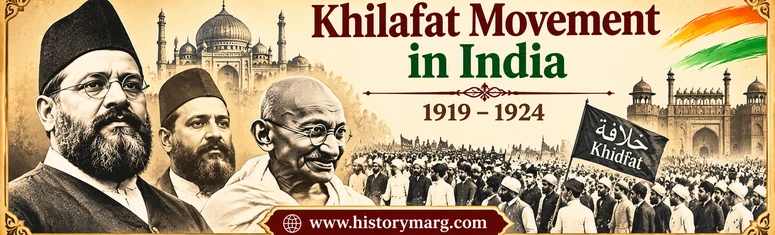
| Khilafat and Non-Cooperation Movement in India, 1919-1922 — A representative image. |
File Information
| Document Information | Details |
|---|---|
| Title | Khalifat and Non-Cooperation Movement in India |
| Article Credit | (Pubd in: Gcwgandhinagar.com) |
| Subject | The Khilafat and Non-Cooperation movements of 1919 to 1922 and the post-war background that brought Hindus and Muslims together against British rule. |
| Category | Study Notes and Khilafat Movement |
| Institution | Government College for Women, Gandhinagar (e-content) |
| Country of Publication | Not clearly identified in the document. |
| Main Topics | Two mass movements of 1919 to 1922, Rowlatt Act and Jallianwala Bagh, Hunter Commission and the House of Lords, Montagu-Chelmsford Reforms, Economic distress after the war, Lucknow Pact and the new Muslim leadership |
| Number of Pages | 8 |
| Language | English |
| File Type | |
| File Size | 197.3 KB |
Summary Note of this Document
Khalifat and Non-Cooperation Movement in India
This study note treats the Khilafat and Non-Cooperation movements as two mass movements organised in 1919 to 1922 to oppose British rule in India. The issues were separate, it says, but they adopted a unified plan of action, which was non-violent non-cooperation. The immediate push came from the Khilafat issue, which was not directly linked to Indian politics but added the advantage of cementing Hindu-Muslim unity against the British. The first section sets out the background in events after the First World War. These included the Rowlatt Act, martial law in Punjab and the Jallianwala Bagh massacre, the Hunter Commission on the Punjab atrocities, which proved to be an eyewash, and the endorsement of General Dyer's action by the House of Lords, with the public collection of 30,000 pounds for him by The Morning Post. The notes then take up the Montagu-Chelmsford Reforms and their scheme of dyarchy, and the alarming economic situation after the war, with rising prices, falling production and heavier taxes and rents. They explain how the Lucknow Pact of 1916, the Rowlatt agitation and the rise of radical Muslims such as Mohammad Ali, Abul Kalam Azad, Hakim Ajmal Khan and Hasan Imam prepared the ground for common action. The e-content is hosted by a women's college in Gandhinagar, and the file is eight pages long.
Core Themes
- Khilafat and Non-Cooperation as parallel movements
- Post-war British policy and Indian anger
- Economic hardship
- Hindu-Muslim common action
- Radical nationalist Muslim leaders
Keywords
About the Khilafat Movement in India
From 1919 to 1922, there was a political campaign by the Muslims of British India, known as the Khilafat Movement, in opposition to the British Indian policies about Turkey and the dismemberment of the Ottoman Empire after the end of the First World War. The Ottoman sultan was also the caliph or religious head of Sunni Muslims globally and many Indian Muslims became concerned for the caliphate as the Allied forces moved against Turkey. Through the Treaty of Sèvres (1920), lands like Palestine, Syria, Lebanon, and Iraq were taken from the empire. While there were protests throughout the Muslim world, the most intense were in India.
Among the leaders were Maulana Mohammad Ali Jauhar, Maulana Shaukat Ali, Hakim Ajmal Khan, Maulana Abul Kalam Azad, Dr. M. A. Ansari and Hasrat Mohani. They set up an All India Khilafat Committee in Lucknow and in 1920 released a Khilafat Manifesto, which urged the British to safeguard the Khilafat. The same year the leaders of the Khilafat Movement allied themselves with the Indian National Congress. Mahatma Gandhi and the leaders of the Khilafat Movement made a pact to work together for the Khilafat cause and for Swaraj. The leaders of Congress like Vallabhbhai Patel and Bal Gangadhar Tilak also gave their support.
The Khilafatists also joined in on the Non-Cooperation Movement, which was a mass non-violent civil disobedience nationwide campaign, which began with a boycott of the legislative councils, government schools and colleges, foreign goods and government functions with the surrender of titles. Gandhi and the Ali brothers were then arrested. Some individuals from the North-West Frontier Province embarked on a protest emigration to Afghanistan, and Indians contributed funds, including one to the Ankara government of Mustafa Kemal. The movement came to an end in 1922 when the Non-Cooperation movement ended. Turkey's secular republic then abolished the caliphate itself in 1924.
From 1919 to 1922, there was what is perhaps seen as the apogee of Hindu-Muslim unity. In India, the period of the movement is identified as an era of the height in the history of civil disobedience, though some questioned if a campaign centered around the Ottoman caliphate might suit a movement for the unity of India. After the movement declined, the leadership was divided. Ata Ullah Shah Bukhari would later establish the Majlis-e-Ahrar-e-Islam, Dr Ansari, Azad, and Hakim Ajmal Khan remained with Gandhi and the Congress, and the Ali brothers entered the Muslim League. Jinnah quit the Congress once his admonitions about the hazards of integrating the caliphate cause with the nationalist movement were ignored.
Complete Khilafat Movement Research Collection
Download the Complete Collection of Khilafat Movement Research PDFs Available on HISTORY MARG