 |
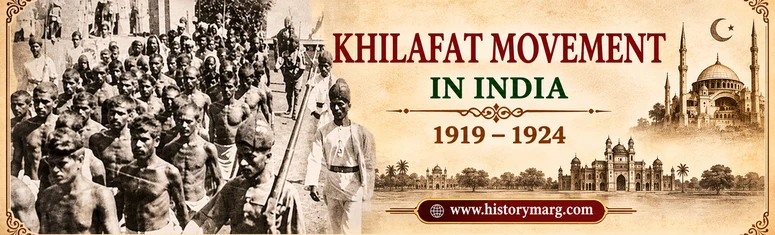
| Book Review: Gail Minault's The Khilafat Movement: Religious Symbolism and Political Mobilization in India — A representative image. |
File Information
| Document Information | Details |
|---|---|
| Title | Book Review: Gail Minault, The Khilafat Movement: Religious Symbolism and Political Mobilization in India |
| Article Credit | Middle East Studies Association Bulletin, ISSN: 0026-3184, Vol.: 17, Issue: 2, Year: 1983, (Pubd in: Academia.edu) |
| Author | Frank Conlon (reviewer) |
| Subject | A review of Gail Minault's 1982 study of the Khilafat Movement as a campaign to unite Indian Muslims politically through religious and cultural symbols. |
| Category | Book Review and Khilafat Movement |
| Institution | Middle East Studies Association of North America |
| Country of Publication | Not clearly identified in the document. |
| Main Topics | The Khilafat Movement as a quest for a pan-Indian Islam, Religious symbolism and political mobilisation, The ulama and Abdul Bari of Firangi Mahal, Alliance with Gandhi's non-cooperation, Collapse of the movement and loss of unity |
| Number of Pages | 2 |
| Language | English |
| File Type | |
| File Size | 151.1 KB |
Summary Note of this Document
Book Review: Gail Minault, The Khilafat Movement: Religious Symbolism and Political Mobilization in India
This review covers Gail Minault's book The Khilafat Movement: Religious Symbolism and Political Mobilization in India, number 16 in the Studies in Oriental Culture series, published by Columbia University Press in New York in 1982. The reviewer says that in 1919 some Muslim leaders in British India began a campaign to press Britain to preserve the Ottoman Empire and to sustain the authority of the sultan, the caliph of Islam. The movement gave the Muslims of the subcontinent a unity of purpose and, once it merged with Gandhi's non-cooperation campaign, briefly shook the foundations of British rule. Readers who know the movement only as a bizarre outlier of pan-Islamic feeling are encouraged by the review to revise that opinion. It quotes Minault's view that the movement was primarily a campaign of Indian Muslim leaders to unite their community politically through religious and cultural symbols meaningful to all strata, and so a quest for a pan-Indian Islam. The review stresses that she goes beyond the careers of politicians to show the part played by religious values and institutions, including the entry of the ulama, with Abdul Bari of Firangi Mahal as crucial as the Ali brothers. It ends with the movement's fracture in 1922, when Gandhi halted non-cooperation, and the steady erosion of Hindu-Muslim unity. The review appeared in the Middle East Studies Association Bulletin, volume 17, issue 2, December 1983. The file has two pages.
Core Themes
- Khilafat as a quest for a pan-Indian Islam
- Religious symbols in political mobilisation
- The role of the ulama
- The 1922 break with Gandhi
- The legacy of the movement
Keywords
About the Khilafat Movement in India
From 1919 to 1922, there was a political campaign by the Muslims of British India, known as the Khilafat Movement, in opposition to the British Indian policies about Turkey and the dismemberment of the Ottoman Empire after the end of the First World War. The Ottoman sultan was also the caliph or religious head of Sunni Muslims globally and many Indian Muslims became concerned for the caliphate as the Allied forces moved against Turkey. Through the Treaty of Sèvres (1920), lands like Palestine, Syria, Lebanon, and Iraq were taken from the empire. While there were protests throughout the Muslim world, the most intense were in India.
Among the leaders were Maulana Mohammad Ali Jauhar, Maulana Shaukat Ali, Hakim Ajmal Khan, Maulana Abul Kalam Azad, Dr. M. A. Ansari and Hasrat Mohani. They set up an All India Khilafat Committee in Lucknow and in 1920 released a Khilafat Manifesto, which urged the British to safeguard the Khilafat. The same year the leaders of the Khilafat Movement allied themselves with the Indian National Congress. Mahatma Gandhi and the leaders of the Khilafat Movement made a pact to work together for the Khilafat cause and for Swaraj. The leaders of Congress like Vallabhbhai Patel and Bal Gangadhar Tilak also gave their support.
The Khilafatists also joined in on the Non-Cooperation Movement, which was a mass non-violent civil disobedience nationwide campaign, which began with a boycott of the legislative councils, government schools and colleges, foreign goods and government functions with the surrender of titles. Gandhi and the Ali brothers were then arrested. Some individuals from the North-West Frontier Province embarked on a protest emigration to Afghanistan, and Indians contributed funds, including one to the Ankara government of Mustafa Kemal. The movement came to an end in 1922 when the Non-Cooperation movement ended. Turkey's secular republic then abolished the caliphate itself in 1924.
From 1919 to 1922, there was what is perhaps seen as the apogee of Hindu-Muslim unity. In India, the period of the movement is identified as an era of the height in the history of civil disobedience, though some questioned if a campaign centered around the Ottoman caliphate might suit a movement for the unity of India. After the movement declined, the leadership was divided. Ata Ullah Shah Bukhari would later establish the Majlis-e-Ahrar-e-Islam, Dr Ansari, Azad, and Hakim Ajmal Khan remained with Gandhi and the Congress, and the Ali brothers entered the Muslim League. Jinnah quit the Congress once his admonitions about the hazards of integrating the caliphate cause with the nationalist movement were ignored.
Complete Khilafat Movement Research Collection
Download the Complete Collection of Khilafat Movement Research PDFs Available on HISTORY MARG