 |
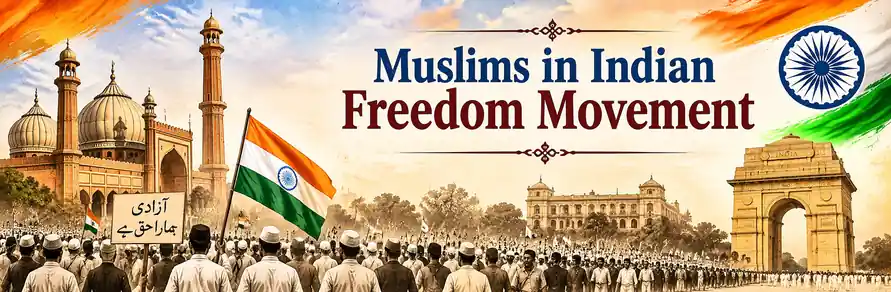
| Historical image illustrating Empowered Voices: The Freedom Struggle of Muslim Women in Colonial Bengal and the role of Indian Muslims in the freedom movement. |
File Information
| Document Information | Details |
|---|---|
| Title | Empowered Voices: The Freedom Struggle of Muslim Women in Colonial Bengal |
| Article Credit | Year: 2023, (Pubd in: ResearchGate) |
| Author | Hilal Ahmad Tantray (Research Scholar, Jamia Millia Islamia, New Delhi) |
| Subject | The part played by Bengali Muslim women in the independence struggle in colonial Bengal, including political activism, advocacy and underground work. |
| Category | Women in the Freedom Struggle |
| Institution | Jamia Millia Islamia, New Delhi |
| Country of Publication | India |
| Main Topics | Women in Indian freedom history, Female freedom fighters of Bengal, Muslim women's political activism, Challenging social norms, The Bengali Muslim press and magazines, Patriotism and national movement |
| Number of Pages | 8 |
| Language | English |
| File Type | |
| File Size | 333.2 KB |
Summary Note of this Document
Empowered Voices: The Freedom Struggle of Muslim Women in Colonial Bengal
Hilal Ahmad Tantray starts from the point that the history of the Indian freedom struggle is incomplete without the contributions of women. His abstract says female freedom fighters from Bengal played a critical part in the campaign for independence, resisting British rule in several ways and defying social norms. They took part in political activism, advocacy and underground movements. The paper then concentrates on Muslim women, who, the author writes, gave their lives for the country's freedom and who will remain part of Indian history. It describes the struggle in Bengal in the mid-twentieth century as marked by the fervent participation of Bengali Muslim women, a pivotal and often overlooked role, in which they faced a dual challenge: opposing external colonial oppression while also challenging entrenched social customs at home. The author notes that many works on the role of Muslims in the Indian national movement have appeared but that this subject has received little attention. One example is an article titled The Love of the Motherland published in the magazine Nabanoor by a Muslim woman writer. The sources include Geraldine Forbes's Women in Modern India, Jayanti Maitra on Muslim politics in Bengal, Nurul Islam Mustafa on the Bengali Muslim press, and Sumit Sarkar on the Swadeshi movement. The keywords are patriotism, freedom, women, Bengal and national movement.
Core Themes
- Women's contribution to the freedom struggle
- Bengali Muslim women as activists
- Dual struggle against colonial rule and social restriction
- The Bengali Muslim press
- Overlooked voices in national history
Keywords
About the Role of Muslims in the Indian Freedom Struggle
Muslims were involved in the struggle against British rule from the very beginning through to 1947. Nawab Siraj ud-Daulah of Bengal lost the Battle of Plassey to the East India Company in 1757. In the latter part of the 18th century Hyder Ali and his son Tipu Sultan of Mysore were at war with the Company in the Anglo-Mysore Wars, employing iron-cased rockets against the British. Tipu Sultan died in the defence of Srirangapatna in 1799. Throughout that long period there were various reform movements too, the most notable being that started by Shah Waliullah in Delhi and the Faraizi movement of Haji Shariatullah in Bengal, both of which were responses to the waning power of the Mughals and the impact of the colonial presence.
The 1857 revolt was essentially a sepoys' revolt with Muslim sepoys and leaders at its heart. Bahadur Shah Zafar, the last Mughal emperor, was the figurehead of the revolt in Delhi and the revolt was fought by sepoys of both Hindu and Muslim faiths. Other key leaders were Maulvi Ahmadullah Shah of Faizabad (killed June 1858), Khan Bahadur Khan of Bareilly and Begum Hazrat Mahal of Awadh. Maulvi Muhammad Baqir, editor of the Delhi Urdu Akhbar, was executed in September 1857. The British were extremely suspicious of Muslims after the revolt and the reprisals were severe, particularly in Delhi and the UP, with many of the scholars and ordinary families caught in the crossfire.
After 1857 a number of Muslim leaders turned to education and organisation. Darul Uloom Deoband was set up in 1866 and Sir Syed Ahmad Khan established the Aligarh institution which in due course produced a large number of nationalists. The Silk Letter Movement (1913-1920) led by Maulana Mahmud Hasan and Ubaidullah Sindhi attempted to raise funds overseas against the British and Mahmud Hasan was detained in Malta. The Khilafat Movement (1919-1924) with the Ali brothers (Muhammad Ali Jauhar and Shaukat Ali), Bi Amma, Hakim Ajmal Khan and Dr. M. A. Ansari was conducted in tandem with Gandhi's Non-Cooperation Movement. Maulana Hasrat Mohani called for full independence in 1921 and coined the slogan Inquilab Zindabad. Muslim leaders also took the helm of the Indian National Congress with Badruddin Tyabji (1887), Muhammad Ali Jauhar (1923), Dr. M. A. Ansari (1927) and Maulana Abul Kalam Azad who led the party again from 1940 to 1946. Khan Abdul Ghaffar Khan organised the non-violent Khudai Khidmatgar movement in the North-West Frontier. Ashfaqulla Khan was hanged in 1927 for his role in the Kakori conspiracy and Shah Nawaz Khan of the Indian National Army was one of the officers tried at the Red Fort.
A word on the figures. There are all sorts of stats about Muslim participation floating around online and some of them are simply incorrect. The figure that 61,945 of the 95,300 names at India Gate are that of Muslim freedom fighters has been shot down by a number of fact checkers. India Gate is not a list of freedom fighters. It's a memorial to some 13,000 soldiers of the British Indian Army who died in the First World War and the Third Anglo-Afghan War. For the actual numbers, the Dictionary of Martyrs: India's Freedom Struggle (1857-1947) put together by the Indian Council of Historical Research and published by the Ministry of Culture in 2019 is the definitive source.
Complete Muslim Freedom Struggle Research Collection
Download the complete collection of research PDFs on the role of Muslims in India's freedom movement available on HISTORY MARG