 |
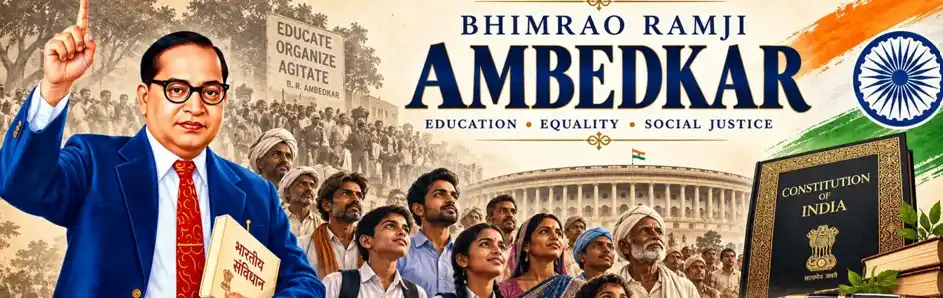
| Ambedkar and the Dalit Buddhist Movement in India — A representative image. |
File Information
| Document Information | Details |
|---|---|
| Title | Ambedkar and The Dalit Buddhist Movement in India (1950-2000) |
| Article Credit | International Journal of Arts Humanities and Social Sciences, Vol.: 2, Issue: 6, Year: 2017, (Pubd in: Ijahss.com) |
| Author | Dr. Shaji. A (Faculty Member, Department of History, School of Distance Education, University of Kerala, Palayam, Thiruvananthapuram) |
| Subject | A study of Ambedkar's turn to Buddhism and the later Dalit Buddhist movement in India, with emphasis on conversion as a route to equality and social justice. |
| Category | History |
| Institution | International Journal of Arts Humanities and Social Sciences |
| Main Topics | B. R. Ambedkar's conversion to Buddhism, Dalit emancipation and untouchability, Caste system and Hinduism, Buddhist revival in India, Dalit Buddhist movement after 1956, Social justice, equality, and fraternity, Political and constitutional reform, Dalit politics in Maharashtra and Uttar Pradesh |
| Number of Pages | 6 |
| Language | English |
| File Type | |
| File Size | 266.3 KB |
Summary Note of this Document
Ambedkar and The Dalit Buddhist Movement in India (1950-2000)
Ambedkar and The Dalit Buddhist Movement in India (1950-2000) examines B. R. Ambedkar's religious conversion and the political meanings attached to Dalit Buddhism after 1956. It traces his long move away from Hinduism, the conferences and writings that shaped that decision, and the public conversion at Deekshabhoomi, Nagpur, where he and large numbers of followers accepted Buddhism. The account links that act to his wider critique of caste, untouchability, and Hindu social order. It also places Buddhism inside his project for dignity, equality, and a secular nation-state. The document presents conversion not as private belief alone, but as a strategy for collective liberation and social transformation. It shows how Ambedkar connected Buddhism with liberty, equality, fraternity, and a rejection of hereditary hierarchy. The later sections follow the movement after his death, especially in Maharashtra and Uttar Pradesh, and note its ties to Dalit politics, the Dalit Panthers, the BSP, and newer campaigns for conversion. At the same time, the text questions the limits of the movement, arguing that Buddhist Dalit mobilization produced gains in self-respect and political consciousness without fully breaking caste divisions or widening benefits to all Dalits.
Core Themes
- conversion as social and political strategy
- critique of untouchability and caste hierarchy
- Buddhism as a path to equality and self-respect
- Ambedkar's constitutional and anti-caste politics
- post-Ambedkar Dalit Buddhist mobilisation
Keywords
About Dr. B. R. Ambedkar
Bhimrao Ramji Ambedkar was born in 1891 as the fourteenth and youngest child of an army Subedar in Mhow. Born into the Mahar caste, which was considered untouchable, Bhimrao faced many hardships at school. He had to sit on a gunny sack that he brought from home. He was not allowed to touch the water vessel or cup, so he could drink water only when the school peon was present to pour it for him. He later described this experience with the words, “No peon, no water.” His mother died when he was very young, and he had a difficult childhood. However, he was the only one of his siblings to pass his examinations and continue to high school, becoming the first person from his community to attend Elphinstone College. With a scholarship from the Maharaja of Baroda, he went on to study at Columbia University and the London School of Economics. He earned doctorates in economics and trained as a barrister at Gray’s Inn. According to the account supplied for this biography, his books were lost when his ship was torpedoed during the First World War.
Despite his education, Ambedkar continued to face prejudice. When he returned to India, he was required to work in Baroda but had to leave the position because of discrimination. His business providing investment consultancy failed when clients learned that he belonged to a community considered untouchable. While working as a professor in Mumbai, his colleagues objected to the idea of him sharing a water jug with his students. These experiences helped spur his activism. He established newspapers to give a voice to marginalized people. He led the Mahad Satyagraha, asserting Dalits’ right to collect water from a public tank, and publicly burned the Manusmriti in 1927. In 1932, he negotiated the Poona Pact with Mahatma Gandhi. Although it involved a difficult compromise, the pact provided reserved seats in legislatures for the Depressed Classes. Ambedkar was outspoken in public life but private by nature. His wife Ramabai died in 1935, and he filled his home in Bombay with a large personal library reported to contain more than 50,000 books. He declared, “I am born a Hindu, but I will not die as one.”
During the period of Indian independence, Jawaharlal Nehru invited Ambedkar to become India’s first Law Minister. Ambedkar chaired the Drafting Committee that prepared the Constitution of India, which abolished the practice of untouchability and established civil liberties and constitutional safeguards, including reservations for historically oppressed communities. He acknowledged the contribution of other constitutional experts, including B. N. Rau, who had prepared an earlier draft. Because of his poor health, including diabetes, Ambedkar married Savita, a doctor who cared for him. In October 1956, he converted to Buddhism in Nagpur along with a vast gathering of followers, commonly estimated at around half a million. He died in his sleep just weeks later, shortly after completing his final major work, The Buddha and His Dhamma. He was posthumously awarded the Bharat Ratna in 1990. His message, “Educate, agitate, organise,” continues to inspire people seeking equality and social justice.
Complete Ambedkar Research Collection
Download the entire collection of Ambedkar research PDFs available on HISTORY MARG