 |
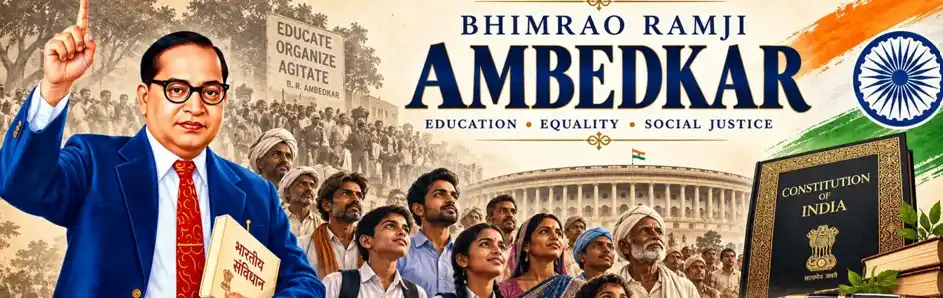
| The Works and Views of Dr. B.R. Ambedkar — A representative image. |
File Information
| Document Information | Details |
|---|---|
| Title | The works and views of Dr. B.R. Ambedkar |
| Article Credit | International Research Journal of Human Resource and Social Sciences, ISSN: ISSN(O): (2349-4085) ISSN(P): (2394-4218), Vol.: Volume 8, Issue: Issue 06, Year: 2021, (Pubd in: Academia.edu) |
| Author | Dr. Roop Raj (Lecturer in Economics, Education Department Haryana) |
| Subject | A critical study of Dr. B.R. Ambedkar's views on social equality, economic reform, labour welfare, constitutional rights, and planned development. |
| Category | Journal article |
| Institution | Association of Academic Researchers and Faculties (AARF) |
| Main Topics | B. R. Ambedkar's social reform ideas, Economic justice and welfare, Labour welfare and trade unionism, Indian Constitution and fundamental rights, Planned economic development, Untouchability and caste discrimination, Agrarian reform and landholdings, State intervention in the economy |
| Number of Pages | 14 |
| Language | English |
| File Type | |
| File Size | 157.0 KB |
Summary Note of this Document
The works and views of Dr. B.R. Ambedkar
The article explores the works and views of Dr. B.R. Ambedkar through the lens of social equality, economic policy, labour reform, and constitutional thought. It presents Ambedkar as a social reformer, economist, jurist, and principal architect of the Constitution of India, and argues that his ideas remain relevant for understanding caste injustice and democratic development in India. The discussion moves from his critique of untouchability and caste hierarchy to his emphasis on the economic uplift of Dalits, farmers, workers, women, and other weaker sections. It highlights his speeches on taxation, prohibition, budgets, industrial welfare, social security, water projects, and rehabilitation, showing how he linked public finance and state policy to the welfare of ordinary people. The article also foregrounds Ambedkar's concern with labour rights, fair wages, arbitration, and industrial training, as well as his advocacy of planned development, irrigation, and inclusive growth. A substantial portion examines his economic writings on the rupee, public finance, land fragmentation, industrialization, and state socialism, concluding that his vision of democracy joined political rights with social and economic justice.
Core Themes
- Social equality and anti-caste reform
- Economic upliftment of oppressed groups
- Labour rights and welfare policy
- Public finance and fiscal responsibility
- Planned development and state intervention
Keywords
About Dr. B. R. Ambedkar
Bhimrao Ramji Ambedkar was born in 1891 as the fourteenth and youngest child of an army Subedar in Mhow. Born into the Mahar caste, which was considered untouchable, Bhimrao faced many hardships at school. He had to sit on a gunny sack that he brought from home. He was not allowed to touch the water vessel or cup, so he could drink water only when the school peon was present to pour it for him. He later described this experience with the words, “No peon, no water.” His mother died when he was very young, and he had a difficult childhood. However, he was the only one of his siblings to pass his examinations and continue to high school, becoming the first person from his community to attend Elphinstone College. With a scholarship from the Maharaja of Baroda, he went on to study at Columbia University and the London School of Economics. He earned doctorates in economics and trained as a barrister at Gray’s Inn. According to the account supplied for this biography, his books were lost when his ship was torpedoed during the First World War.
Despite his education, Ambedkar continued to face prejudice. When he returned to India, he was required to work in Baroda but had to leave the position because of discrimination. His business providing investment consultancy failed when clients learned that he belonged to a community considered untouchable. While working as a professor in Mumbai, his colleagues objected to the idea of him sharing a water jug with his students. These experiences helped spur his activism. He established newspapers to give a voice to marginalized people. He led the Mahad Satyagraha, asserting Dalits’ right to collect water from a public tank, and publicly burned the Manusmriti in 1927. In 1932, he negotiated the Poona Pact with Mahatma Gandhi. Although it involved a difficult compromise, the pact provided reserved seats in legislatures for the Depressed Classes. Ambedkar was outspoken in public life but private by nature. His wife Ramabai died in 1935, and he filled his home in Bombay with a large personal library reported to contain more than 50,000 books. He declared, “I am born a Hindu, but I will not die as one.”
During the period of Indian independence, Jawaharlal Nehru invited Ambedkar to become India’s first Law Minister. Ambedkar chaired the Drafting Committee that prepared the Constitution of India, which abolished the practice of untouchability and established civil liberties and constitutional safeguards, including reservations for historically oppressed communities. He acknowledged the contribution of other constitutional experts, including B. N. Rau, who had prepared an earlier draft. Because of his poor health, including diabetes, Ambedkar married Savita, a doctor who cared for him. In October 1956, he converted to Buddhism in Nagpur along with a vast gathering of followers, commonly estimated at around half a million. He died in his sleep just weeks later, shortly after completing his final major work, The Buddha and His Dhamma. He was posthumously awarded the Bharat Ratna in 1990. His message, “Educate, agitate, organise,” continues to inspire people seeking equality and social justice.
Complete Ambedkar Research Collection
Download the entire collection of Ambedkar research PDFs available on HISTORY MARG