 |
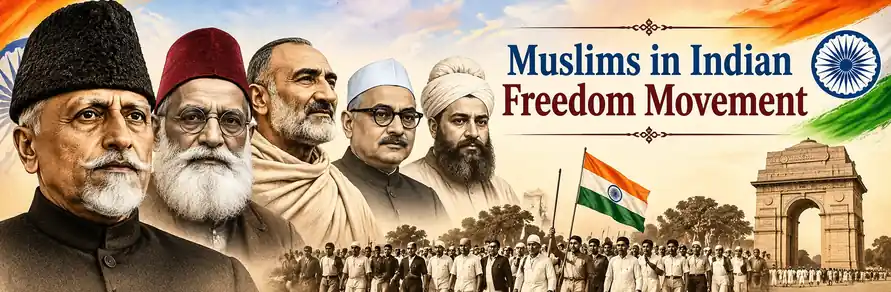
| Historical illustration related to Muslims and the Rowlatt Act Satyagraha and the contribution of Indian Muslims to India's freedom movement. |
File Information
| Document Information | Details |
|---|---|
| Title | Muslims and the Rowlatt Act Satyagraha |
| Article Credit | Proceedings of the Indian History Congress, 63rd Session, Amritsar 2002 (Kolkata, 2003), Year: 2002, (Pubd in: Jstor.org) |
| Author | D. Abul Fazal (Vaniyambadi, Tamil Nadu) |
| Subject | The part Muslims played in the Rowlatt Act Satyagraha of 1919 and why their participation gave the movement a mass base. |
| Category | Indian National Movement |
| Institution | Indian History Congress |
| Country of Publication | India |
| Main Topics | Rowlatt Act Satyagraha as an epoch-making event, Khilafat grievances of Indian Muslims, Pan-Islamism and 1919, Gandhi's rise as a national figure, Repressive laws used against Muslims, Externment of Azad, Hasrat Mohani and Zafar Ali Khan |
| Number of Pages | 10 |
| Language | English |
| File Type | |
| File Size | 8.69 MB |
Summary Note of this Document
Muslims and the Rowlatt Act Satyagraha
D. Abul Fazal argues that the Rowlatt Act Satyagraha was an epoch-making event in the history of the Indian national movement and in Gandhi's career. It began the change of the national movement from an elite effort to a mass movement and the change of Gandhi from a peripheral figure to a national one. According to the paper, those changes would not have been possible without Muslim participation. Muslims, angered over the Khilafat issue and its uncertain future, joined in large numbers and brought a mass base, and historical works have not given this factor enough weight. The author describes 1919 as a landmark that saw the growth of Pan-Islamism as a force in Indian politics and the emergence of Gandhi as a major political leader. It reviews the anti-British feeling among Indian Muslims after the annulment of the partition of Bengal and after Britain's war against Turkey, and the fresh anger caused by the Rowlatt Bills of 6 February 1919, which were to replace the Defence of India Act. It points out that earlier laws such as the Press Act of 1910 and the Defence of India Act of 1915 had been applied more against Muslims and their press, and that Abul Kalam Azad, Hasrat Mohani and Zafar Ali Khan were externed. The paper begins on page 733 of the Proceedings, and the file is a scan.
Core Themes
- Muslim participation in the Rowlatt Satyagraha
- Khilafat anger and Pan-Islamism
- Gandhi's rise as a national leader
- Repressive laws and the Muslim press
- From an elite to a mass movement
Keywords
About the Role of Muslims in the Indian Freedom Struggle
Muslims were involved in the struggle against British rule from the very beginning through to 1947. Nawab Siraj ud-Daulah of Bengal lost the Battle of Plassey to the East India Company in 1757. In the latter part of the 18th century Hyder Ali and his son Tipu Sultan of Mysore were at war with the Company in the Anglo-Mysore Wars, employing iron-cased rockets against the British. Tipu Sultan died in the defence of Srirangapatna in 1799. Throughout that long period there were various reform movements too, the most notable being that started by Shah Waliullah in Delhi and the Faraizi movement of Haji Shariatullah in Bengal, both of which were responses to the waning power of the Mughals and the impact of the colonial presence.
The 1857 revolt was essentially a sepoys' revolt with Muslim sepoys and leaders at its heart. Bahadur Shah Zafar, the last Mughal emperor, was the figurehead of the revolt in Delhi and the revolt was fought by sepoys of both Hindu and Muslim faiths. Other key leaders were Maulvi Ahmadullah Shah of Faizabad (killed June 1858), Khan Bahadur Khan of Bareilly and Begum Hazrat Mahal of Awadh. Maulvi Muhammad Baqir, editor of the Delhi Urdu Akhbar, was executed in September 1857. The British were extremely suspicious of Muslims after the revolt and the reprisals were severe, particularly in Delhi and the UP, with many of the scholars and ordinary families caught in the crossfire.
After 1857 a number of Muslim leaders turned to education and organisation. Darul Uloom Deoband was set up in 1866 and Sir Syed Ahmad Khan established the Aligarh institution which in due course produced a large number of nationalists. The Silk Letter Movement (1913-1920) led by Maulana Mahmud Hasan and Ubaidullah Sindhi attempted to raise funds overseas against the British and Mahmud Hasan was detained in Malta. The Khilafat Movement (1919-1924) with the Ali brothers (Muhammad Ali Jauhar and Shaukat Ali), Bi Amma, Hakim Ajmal Khan and Dr. M. A. Ansari was conducted in tandem with Gandhi's Non-Cooperation Movement. Maulana Hasrat Mohani called for full independence in 1921 and coined the slogan Inquilab Zindabad. Muslim leaders also took the helm of the Indian National Congress with Badruddin Tyabji (1887), Muhammad Ali Jauhar (1923), Dr. M. A. Ansari (1927) and Maulana Abul Kalam Azad who led the party again from 1940 to 1946. Khan Abdul Ghaffar Khan organised the non-violent Khudai Khidmatgar movement in the North-West Frontier. Ashfaqulla Khan was hanged in 1927 for his role in the Kakori conspiracy and Shah Nawaz Khan of the Indian National Army was one of the officers tried at the Red Fort.
A word on the figures. There are all sorts of stats about Muslim participation floating around online and some of them are simply incorrect. The figure that 61,945 of the 95,300 names at India Gate are that of Muslim freedom fighters has been shot down by a number of fact checkers. India Gate is not a list of freedom fighters. It's a memorial to some 13,000 soldiers of the British Indian Army who died in the First World War and the Third Anglo-Afghan War. For the actual numbers, the Dictionary of Martyrs: India's Freedom Struggle (1857-1947) put together by the Indian Council of Historical Research and published by the Ministry of Culture in 2019 is the definitive source.
Complete Muslim Freedom Struggle Research Collection
Download the complete collection of research PDFs on the role of Muslims in India's freedom movement available on HISTORY MARG