File Information
| Document Information | Details |
|---|---|
| Title | Mohan Das Karamchand Gandhi: Spiritual Guru or Political Leader? |
| Article Credit | Academia.edu |
| Author | Subhadra Mitra Channa |
| Subject | An academic paper exploring Gandhi's dual identity as a spiritual and political leader, his methods of non-violent protest, and his impact on India's freedom movement. |
| Category | History |
| Institution | Not clearly stated in the document. |
| Country of Publication | Not clearly stated in the document. |
| Main Topics | Gandhi's spiritual persona and political leadership, Indian concepts of rulership and legitimacy, Gandhi's personal life and transformation, Non-violent protest and Satyagraha, Gandhi's relationship with critics and detractors, Femininity and gender in Gandhi's philosophy, Impact of Gandhian ideas on Indian society and economy |
| Number of Pages | 26 |
| Language | English |
| File Type | |
| File Size | 451.2 KB |
Summary Note of this Document
Subhadra Mitra Channa's paper, presented at the conference 'Biographies and Liberation,' explores the question of whether Mohandas Karamchand Gandhi was primarily a spiritual leader or a political one. Drawing on her anthropological fieldwork, Channa illustrates Gandhi's influence in remote Indian villages. She contends that in the Indian context, spiritual authority carries immense power, and Gandhi deliberately cultivated the image of a saint, or Mahatma, to unite a diverse population divided by caste, religion, and language. The paper examines Gandhi's personal life, including his strict upbringing, his marriage to Kasturba, his education in England, and his transformation in South Africa, where he experienced racism and decided to embrace celibacy and simplicity. Channa analyzes Gandhi's non-violent protest methods, his embrace of feminine virtues, and his rejection of colonial educational values. The paper also discusses Gandhi's relationships with critics like B.R. Ambedkar and Subhas Chandra Bose, and the threat posed by Hindu fundamentalists. Ultimately, Channa argues that Gandhi's greatness lies in his integrity and his demonstration that moral courage and non-violence are powerful political weapons.
Core Themes
- Intersection of spirituality and politics
- Non-violence as a powerful political weapon
- Construction of Gandhi's ascetic persona
- Gender, femininity, and androgyny in Gandhi's identity
- Gandhi's legacy and critiques from within the freedom movement
Keywords
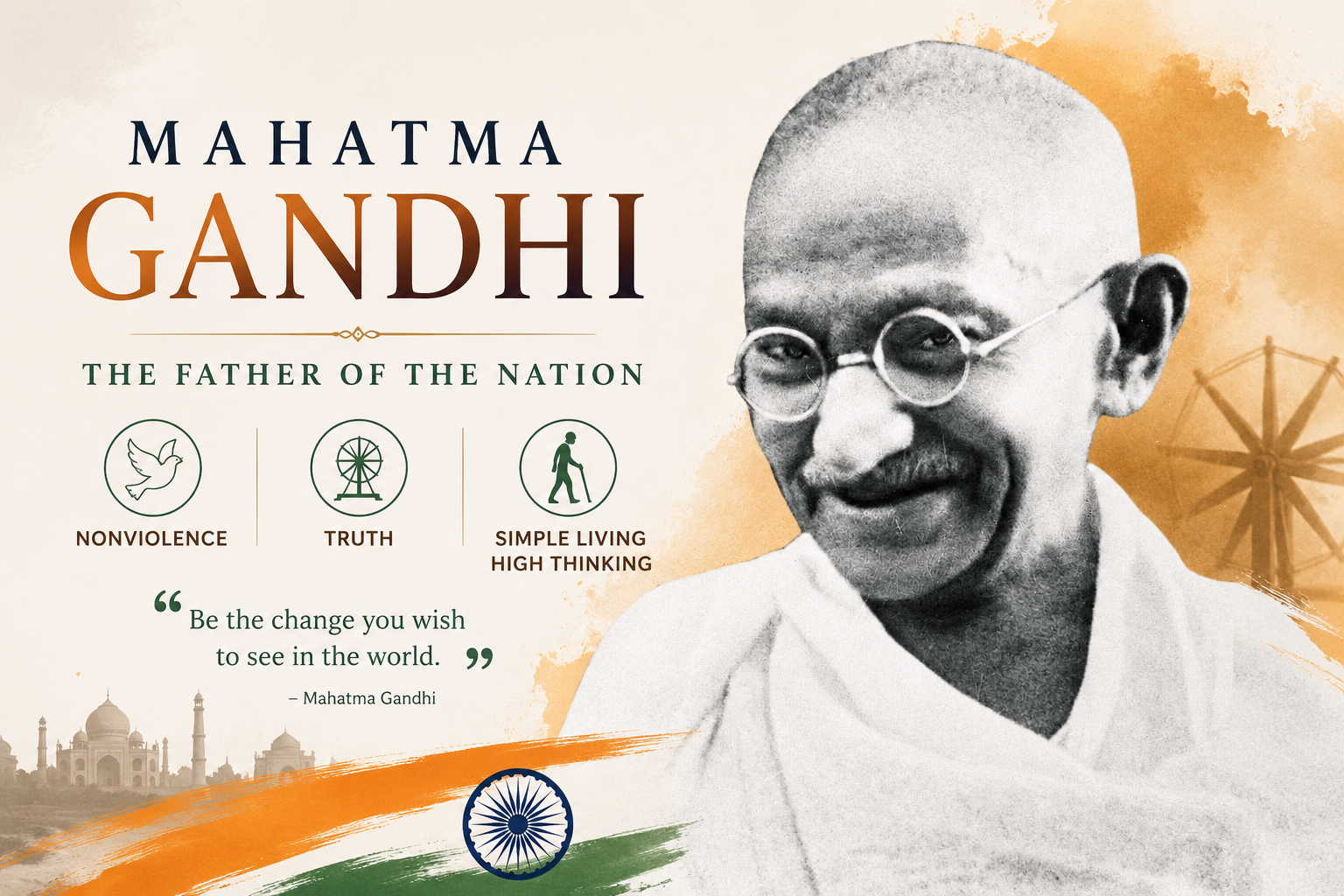
About Mahatma Gandhi
Mahatma Gandhi (1869–1948), born Mohandas Karamchand Gandhi, was an Indian lawyer, anti-colonial nationalist and political thinker who became one of the most influential leaders of India’s struggle for independence. He is particularly known for developing and applying the principles of Satyagraha, truth and nonviolent resistance in political and social movements. Gandhi spent more than two decades in South Africa, where he developed his methods of nonviolent resistance, before returning to India in 1915 and leading major movements against British rule, including the Non-Cooperation Movement, the Salt March and the Quit India Movement. He was married to Kasturba Gandhi in 1883, and their family life remained an important part of his personal history. Gandhi was also a prolific writer whose important works include Hind Swaraj, Satyagraha in South Africa, and his autobiography The Story of My Experiments with Truth. His ideas addressed not only political freedom but also religious harmony, social equality, self-reliance, poverty, women’s rights and the struggle against untouchability. His philosophy of nonviolence and Satyagraha later influenced civil-rights and freedom movements around the world.