 |
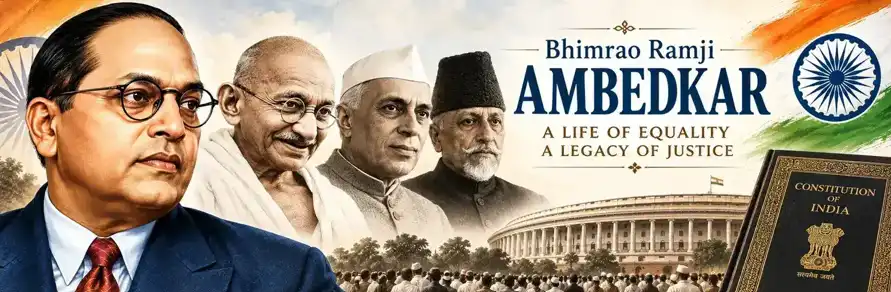
| Views of Ambedkar on Social Justice — A representative image. |
File Information
| Document Information | Details |
|---|---|
| Title | Views of Ambedkar on Social Justice |
| Article Credit | (Pubd in: Academia.edu) |
| Subject | This document examines Ambedkar's theory of social justice, especially how liberty, equality, fraternity, and social democracy work together. It also compares his position with other theories of justice and critiques of caste-based inequality. |
| Category | Essay |
| Country of Publication | Not clearly identified in the document. |
| Main Topics | Ambedkar's concept of social justice, Liberty, equality, and fraternity, Social democracy, Critique of caste hierarchy and Chaturvarna, Comparative theories of justice, Human rights and dignity, Constitutional equality and legal justice |
| Number of Pages | 5 |
| Language | English |
| File Type | |
| File Size | 62.9 KB |
Summary Note of this Document
Views of Ambedkar on Social Justice
This document discusses Ambedkar's understanding of social justice and explains how he linked justice to liberty, equality, fraternity, and social democracy. It presents justice not merely as distribution of wealth, but as a moral and social order grounded in human dignity, mutual respect, rights, and obligations. The text emphasizes that political democracy cannot endure without social democracy, and it treats the three principles of liberty, equality, and fraternity as an inseparable unity. Ambedkar's views are set against a series of other theories of justice, including those associated with Brunetto Latini, Hart, Brecht, Messner, David Hume, Marxism, Gandhian Sarvodaya, Hindu social order, Aristotle, Thrasymachus, and Nietzsche. Through these comparisons, the document argues that many older or rival theories are inadequate because they either normalize inequality, remain impractical, or fail to address human equality comprehensively. The final emphasis is on social transformation: abolishing caste distinctions, strengthening constitutional equality, and building a society where every person receives a rightful place and equal worth. The document consistently frames Ambedkar's approach as holistic, ethical, and oriented toward a social democracy in which human values are central.
Core Themes
- Ambedkar's social justice philosophy
- Unity of liberty, equality, and fraternity
- Critique of caste and social inequality
- Social democracy as a condition of political democracy
- Comparison with Western and Indian theories of justice
Keywords
About Dr. B. R. Ambedkar
Bhimrao Ramji Ambedkar was born in 1891 as the fourteenth and youngest child of an army Subedar in Mhow. Born into the Mahar caste, which was considered untouchable, Bhimrao faced many hardships at school. He had to sit on a gunny sack that he brought from home. He was not allowed to touch the water vessel or cup, so he could drink water only when the school peon was present to pour it for him. He later described this experience with the words, “No peon, no water.” His mother died when he was very young, and he had a difficult childhood. However, he was the only one of his siblings to pass his examinations and continue to high school, becoming the first person from his community to attend Elphinstone College. With a scholarship from the Maharaja of Baroda, he went on to study at Columbia University and the London School of Economics. He earned doctorates in economics and trained as a barrister at Gray’s Inn. According to the account supplied for this biography, his books were lost when his ship was torpedoed during the First World War.
Despite his education, Ambedkar continued to face prejudice. When he returned to India, he was required to work in Baroda but had to leave the position because of discrimination. His business providing investment consultancy failed when clients learned that he belonged to a community considered untouchable. While working as a professor in Mumbai, his colleagues objected to the idea of him sharing a water jug with his students. These experiences helped spur his activism. He established newspapers to give a voice to marginalized people. He led the Mahad Satyagraha, asserting Dalits’ right to collect water from a public tank, and publicly burned the Manusmriti in 1927. In 1932, he negotiated the Poona Pact with Mahatma Gandhi. Although it involved a difficult compromise, the pact provided reserved seats in legislatures for the Depressed Classes. Ambedkar was outspoken in public life but private by nature. His wife Ramabai died in 1935, and he filled his home in Bombay with a large personal library reported to contain more than 50,000 books. He declared, “I am born a Hindu, but I will not die as one.”
During the period of Indian independence, Jawaharlal Nehru invited Ambedkar to become India’s first Law Minister. Ambedkar chaired the Drafting Committee that prepared the Constitution of India, which abolished the practice of untouchability and established civil liberties and constitutional safeguards, including reservations for historically oppressed communities. He acknowledged the contribution of other constitutional experts, including B. N. Rau, who had prepared an earlier draft. Because of his poor health, including diabetes, Ambedkar married Savita, a doctor who cared for him. In October 1956, he converted to Buddhism in Nagpur along with a vast gathering of followers, commonly estimated at around half a million. He died in his sleep just weeks later, shortly after completing his final major work, The Buddha and His Dhamma. He was posthumously awarded the Bharat Ratna in 1990. His message, “Educate, agitate, organise,” continues to inspire people seeking equality and social justice.
Complete Ambedkar Research Collection
Download the entire collection of Ambedkar research PDFs available on HISTORY MARG